Skip to Content
Exit

Author Archives: Enerquip

  1. Why Hot Oil Heater Film Temperature Matters

    Comments Off on Why Hot Oil Heater Film Temperature Matters

    When choosing a hot oil heater, film temperature is a crucial factor that is often overlooked. Many consumers focus on aspects like efficiency, burner turn down, and controls, but neglect the importance of film temperature.

    So, why is film temperature critical for industrial heating? And why should plant managers consider it when evaluating hot oil heating systems? Here are a few key reasons to pay close attention to film temperature when selecting a hot oil heater for your plant.

    Film Temperature Impacts the Type of Thermal Fluid Required

    The film temperature in a heater that has space between the tubes, such as Enerquip’s Serpentine Coil Thermal Fluid Heater, is typically 50oF higher than the operating temperature. Most other industrial heater designs on the market use helical coils, which do not have space between the tubes. This lack of space causes uneven heat absorption in the pipe itself, creating a higher film temperature.  The film temperature in a helical coil heater is typically 100oF higher than the operating temperature. So what does this mean?

    It means that with a helical coil heater, you will most likely need to select a more expensive thermal heating fluid. If you are operating at 500oF, in a helical coil heater your film temperature will be 600oF or higher, requiring you to use a much higher grade fluid than you would need if you were utilizing a serpentine coil heater like those we manufacture here at Enerquip.

    At 550oF film temperature, you can run a fluid in the $10-15/gallon range, but in the 600-650oF film temperature range you will need a synthetic fluid in the $40-55/gallon price range. This can have a significant impact when it comes to your facility’s expenses.

    • High film temperature 4,000 Gallon System x $55 per gallon of heating fluid = $220,000
    • Lower film temperature 4,000 Gallon System x $15 per gallon of heating fluid = $60,000

    That is a $160,000 savings as a result of using a thermal fluid heater with a lower film temperature! Obviously, this can vary depending on which brand of fluid you select, but you can see how it adds up!

    Film Temperature Impacts Thermal Fluid Life

    The second aspect of having a lower film temperature is that the thermal heating fluid you select will last much longer than it would in a heater with a higher film temperature. The rule of thumb from fluid suppliers is that for every 10oC (18oF) increase in film temperature, the degradation rate in the fluid will double. Since the film temperature in an Enerquip hot oil heater with a serpentine coil is 50oF lower than those with a helical coil, you will see significantly less degradation in fluid.

    As a result, many of our heaters are running with the same initial fill of fluid for 15-20 years, well past the estimated life of the heat transfer fluid!

    Save Money Now and In the Future With Lower Hot Oil Heater Film Temperatures

    There are many benefits that come from implementing thermal fluid heaters from Enerquip in your facility. While mechanical benefits such as high efficiency, ease of repair, robust coil design, large combustion chamber, and longer coil life are all very important, perhaps one of the most significant benefits is the heater’s lower film temperature.

    Interested in learning more about how our heaters with low film temperatures can help to save your facility money in the long- and short term? Give us a call today at (833) 516-6888 or contact us online for more information or to request a quote.

    More from the Enerquip Blog

  2. Shell and Tube Heat Exchangers: A Guide to Industry Standards

    Comments Off on Shell and Tube Heat Exchangers: A Guide to Industry Standards

    Shell and tube heat exchangers are critical components across various industries, from oil refining and pharmaceutical production to food safety and brewing. Despite the diversity of these industries, they all share a common challenge: selecting the right shell and tube heat exchanger for their specific operations.

    Heat exchangers, when crafted with high-quality materials and meticulous standards, can have a long lifespan. However, when it’s time for a new purchase, making the right choice is essential. The configuration, codes, and industry standards your equipment meets are crucial factors that impact its performance and compliance. Adhering to these standards ensures that your products are not only of the highest quality but also meet all regulatory requirements.

    Industry standards play a pivotal role in ensuring that shell and tube heat exchangers are built to perform effectively and safely. Selecting an exchanger that meets the necessary criteria is vital for avoiding operational issues and ensuring that your products are safe for distribution.

    The following are key industry standards for shell and tube heat exchangers.

    TEMA Standards

    The Tubular Exchanger Manufacturers Association (TEMA) provides one of the most widely recognized industry standards. TEMA’s standards are categorized into three classes:

    • Class B: For chemical processing applications
    • Class C: For general commercial use
    • Class R: Primarily for petroleum processing, but also suitable for large-scale operations

    Each class addresses specific needs, such as the need for more robust construction in petroleum processing or the use of stainless steel in chemical applications. Understanding these distinctions helps in choosing the right heat exchanger for your industry.

    ASME Standards

    The American Society of Mechanical Engineers (ASME) sets standards that are crucial for the pressurized components of shell and tube heat exchangers, particularly those within the shell. The ASME VIII code is widely applied across various types of equipment, ensuring that the pressurized parts meet strict safety and performance criteria. Many heat exchangers are certified by both ASME and TEMA, as TEMA standards often complement ASME’s broader criteria.

    ANSI Standards

    The American National Standards Institute (ANSI) has been coordinating the U.S. voluntary standardization system for nearly a century. ANSI plays a key role in the development and improvement of industry standards, including those for shell and tube heat exchangers. Regular updates and calls for comments ensure that these standards evolve to meet industry needs.

    PED Standards

    Given the global use of heat exchangers, compliance with international standards is also essential. The Pressure Equipment Directive (PED) is a key standard in the European Union, covering everything from materials and harmonized standards to essential requirements and market surveillance. Adhering to PED ensures that your equipment is safe and legally compliant in the EU market.

    CRN Standards

    For operations in Canada, the Canadian Registration Number (CRN) is mandatory for all boilers, pressure vessels, and fittings. The CRN certifies that the equipment meets the specific safety standards of each province or territory. Understanding the CRN system, which includes province-specific codes, is crucial for ensuring compliance in Canadian markets.

    3-A Sanitary Standards Inc.

    Originating in the 1920s, 3-A Sanitary Standards were developed to ensure that equipment used in the dairy industry, and later food and pharmaceutical industries, could be easily cleaned and maintained. These standards, established by a collaboration of equipment fabricators, regulatory sanitarians, and processors, ensure that all equipment can be cleaned effectively, whether through a clean-in-place (CIP) system or manual cleaning.

    When purchasing a shell and tube heat exchanger, getting the right certifications is crucial. Enerquip’s team of engineers will know what your industry requires and will work with you to meet your needs. We invite you to contact us or request a quote today. 


    More from the Enerquip Blog

  3. Enerquip Supports Local Church with $500 Donation through Employee Match Program

    Comments Off on Enerquip Supports Local Church with $500 Donation through Employee Match Program

    As part of its employee match program, Enerquip has proudly donated $500 to Ss. Peter & Paul Catholic Church in Gilman. The donation was presented at the church’s annual Bazaar and will be used to support the church’s outreach efforts and operational expenses.

    Enerquip remains committed to fostering a culture of giving by matching employee contributions to charitable organizations, including volunteer hours, dollar for dollar up to $500 per employee per calendar year. This initiative is part of Enerquip’s broader mission to encourage and empower its employees to make a positive impact in their communities.

    The donation reflects the dedication of Enerquip Design Engineer Linda Olejnichak, who not only contributed financially but also devoted significant volunteer hours as the Chairperson of the church’s Bazaar.

    Learn more about Enerquip’s Community Giving program.

  4. Closed-Loop Process Cooling Reduces Water, Energy Use in Pharmaceutical Manufacturing

    Comments Off on Closed-Loop Process Cooling Reduces Water, Energy Use in Pharmaceutical Manufacturing

    The pharmaceutical industry plays a vital role in keeping people healthy and saving lives through its products and innovations. However, the industry also faces significant challenges, particularly in terms of water and energy consumption. Like many industries, pharmaceuticals are working hard to address these issues.

    Water is the most widely used resource in pharmaceutical manufacturing. It’s essential as a starting material, an added substance, and in the processing of products.

    Water Usage Challenges

    Given the critical role of water in pharmaceutical production, reducing its usage is a significant challenge. Many companies are now focused on conserving water to achieve two main objectives: improving sustainability and reducing operational costs.

    Cooling towers are one of the major sources of high water usage. They play a crucial role in the production of various products, including:

    • Forming tablets
    • Cooling creams and ointments
    • Sterilizing liquids
    • Batch processing

    Unfortunately, cooling towers typically consume between 1 and 1.5 million gallons of water annually. This water is often used only once before being discarded, frequently leaving the plant contaminated.

    In addition to their high water usage, cooling towers are also heavy energy consumers. Fans and pumps run continuously, demanding significant energy. Moreover, the contamination caused by algae, solid deposits, microbiological growth, airborne diseases, and scaling necessitates chemical treatments, further increasing energy consumption and water contamination.

    The Solution: Shell and Tube Heat Exchangers

    Given these issues, many pharmaceutical manufacturers are now opting to replace traditional cooling towers with more efficient alternatives, such as closed-loop process cooling systems.

    Closed-loop systems offer several benefits, including:

    • Reduced water and energy consumption
    • Lower operational costs
    • Enhanced control over cooling temperatures
    • Increased profitability

    These systems utilize heat exchangers and an adiabatic chamber to cool process water, which is then recirculated at the correct temperature. When temperatures rise, a cooling mist is sprayed into the air inside the chamber. This mist evaporates instantly, preventing any negative impact on the cooling process. The cooled water is then circulated through the process machines.

    Up to 98% Water Savings

    This technology significantly reduces water consumption by reusing water rather than discarding it after a single use. Water savings of up to 98% can be achieved compared to traditional cooling towers.

    Closed-loop systems also help reduce contamination issues associated with cooling towers. The recycled water meets sanitary requirements, reducing the risk of problems like airborne diseases. Additionally, these systems lower energy consumption. In some climates, plants can even turn off chillers during colder months, further reducing energy use.

    In today’s rapidly evolving world, it’s essential for pharmaceutical manufacturers to operate efficiently and safely. For these companies to remain profitable, finding ways to cut costs while reducing water and energy use is crucial.

    To learn more about how shell and tube heat exchangers can enhance your operations, consult the experts at Enerquip.


    More from the Enerquip Blog

  5. Selecting Tube Sizing in a Shell and Tube Heat Exchanger

    Comments Off on Selecting Tube Sizing in a Shell and Tube Heat Exchanger

    When designing a shell and tube heat exchanger, selecting the appropriate tubing sizes is crucial for optimal performance. Engineers and process managers must consider various factors, such as application requirements, pressure drop, and flow characteristics, to determine the most suitable tubing dimensions. In this article, we will delve into the intricacies of shell and tube heat exchanger tube sizing.

    Standard Tubing Sizes and Their Applications

    Shell and tube heat exchangers employ standardized tubing sizes to facilitate manufacturing and interchangeability. Some common tubing sizes and their typical applications include:

    • 3/8” (9.57 mm): Ideal for small-scale operations, including pilot projects, medical devices and precision cooling systems. Often used in pharmaceutical applications.
    • 1/2″ (12.7 mm): Also used in small-scale operations, including laboratory setups. Often used in industries like electronics, aerospace, and pharmaceuticals.
    • 3/4″ (19.05 mm): Widely used in small to medium-sized heat exchangers for various industries, such as chemical processing, food and beverage, and pharmaceuticals.
    • 1″ (25.4 mm): Suitable for medium to large-scale applications, including oil and gas, power generation, and desalination plants.
    • 1 1/4″ (31.75 mm): Commonly found in large-scale industrial applications, such as refineries, petrochemical plants, and power stations.
    • 1 1/2″ (38.1 mm): Employed in high-flow, low-pressure applications, such as cooling water systems and condensers.

    Pressure

    One of the primary factors in determining tube diameter is the pressure of the fluids flowing through the heat exchanger. The tube walls need to be thick enough to withstand the operating pressures without failure. Higher pressures generally require thicker tube walls which may then require larger tube diameters to maintain flow characteristics.  Typical tube wall thicknesses range from 16 gauge (0.065 inches) to 10 gauge (0.135 inches), with thicker walls used for higher pressure applications.

    Fluid Flow

    Another major factor in tube diameter selection is the flow rate and velocity of the fluids passing through the heat exchanger. Higher flow rates generally require larger tube diameters to maintain an acceptable pressure drop. If the tubes are too small, the fluid velocity will be too high, leading to excessive pressure drops, cavitation, erosion, and higher pumping costs. Conversely, if the tubes are too large, the fluid velocity will be too low, resulting in poor heat transfer performance and potential fouling issues.

    The ideal fluid velocity in a shell and tube heat exchanger is typically 3-6 ft/s for low-viscosity liquids and 50-100 ft/s for gases. Maintaining these velocity ranges helps optimize heat transfer while avoiding excessive pressure drop. The tube diameter must be selected based on the expected flow rates of the hot and cold fluids, with higher flow rates likely requiring larger diameter tubes.

    Application and Duty Cycle

    The specific application and duty cycle of the heat exchanger also affect the optimal tube diameter. For example, a heat exchanger used in a continuous industrial process will have different requirements than one used intermittently in an HVAC system. Continuous processes may need to handle higher flow rates, requiring larger tube diameters.

    The heat exchanger’s duty cycle – whether it operates 24/7 or just a few hours per day – can impact tube diameter selection. Heavier duty cycles may call for thicker tube walls and larger diameters to handle increased thermal and mechanical stresses. Other application-specific factors like corrosion, fouling, and vibration may also influence tube diameter choice. For instance, a heat exchanger handling a highly corrosive fluid may need thicker tube walls and, thus, larger diameters to ensure an adequate service life.

    Thermal and Mechanical Considerations

    Thermal and mechanical requirements also play a role in determining the optimal tube diameter. Smaller tube diameters generally result in higher heat transfer coefficients due to higher fluid velocities and more turbulence. However, very small tubes can lead to excessive pressure drops and fouling issues, requiring a balance between heat transfer performance and pressure drop.

    Mechanically, tube diameter impacts the structural integrity and vibration characteristics of the heat exchanger. Larger diameter tubes are more resistant to vibration-induced fatigue failures, an important consideration for high-vibration applications. Additionally, tube diameter affects the overall weight and size of the heat exchanger, with larger diameter tubes resulting in physically larger units.

    Optimizing Tube Diameter

    As you can see, many interrelated factors determine the optimal tube diameter for a shell and tube heat exchanger. It’s a complex decision requiring careful analysis and trade-offs. Generally, the goal is to select the smallest tube diameter that can still meet pressure, flow, and application requirements while optimizing for heat transfer performance, structural integrity, and cost. This often involves an iterative design process where different tube diameter options are evaluated to find the best overall solution.

    Turn to Enerquip to perform the vital thermal calculations required to optimize your heat exchange solution. Contact us or request a quote today.


  6. Enerquip at ISPE Great Lakes Vendor Day

    Comments Off on Enerquip at ISPE Great Lakes Vendor Day

    Join Enerquip at the ISPE Great Lakes Vendor Day on Wednesday, September 4th, at the Garver Feed Mill in Madison, WI. This event is an excellent opportunity to explore cutting-edge technology, learn from pharmaceutical industry leaders, and connect with professionals in the field.

    Event Highlights

    The day begins at 11:00 AM with registration, networking, and vendor exhibits, where Enerquip will showcase our innovative process equipment solutions at our display table. Be sure to stop by and meet Brady Loertscher and Troy Weik to discover how our high-purity thermal solutions can enhance your operations with greater efficiency and reliability.

    Exciting Sessions

    • 12:00 PM: Hear from Lisa Johnson, CEO of BioForward, Inc., in the keynote session.
    • 12:30 PM: Todd Kapp, CEO of Wautoma Biotech, will present on cloud-based automation in advanced therapies and bioprocess technologies.
    • 1:15 PM: Alejandro Kaiser of Kaiser Global Engineering will discuss process closure.
    • 3:00 PM: Participate in a learning session with Milena McFeeters from Refined Sciences Inc. on the revised ASME BPE standards.
    • 3:45 PM: Richard Mathies of Alfa Laval will share insights on single-use equipment in bioprocessing.

    Networking Opportunities

    The event concludes with networking, light snacks, and beverages from 4:30 PM to 5:30 PM. It’s a perfect chance to engage with industry peers and discuss the latest trends and technologies.

    Don’t miss out on this incredible opportunity to advance your knowledge and connect with industry experts!

    For more information and to become a member, visit the ISPE Great Lakes Chapter website.

  7. Honey Warming Prevents Crystallization

    Comments Off on Honey Warming Prevents Crystallization

    The Sweet Science of Honey Processing: Preventing Crystallization

    Honey is a popular sweetener many people often use while baking, in teas and as a topping on toast or ice cream. When thinking of honey, most envision an amber-colored, sticky liquid that is easily, if slowly, poured from a bottle. This is the most popular form and the state in which honey producers strive to keep their product.

    As many people know, honey is a substance created by bees. The bees extract nectar, or sugars, from flowers to transform into honey in their hives. The substance is therefore essentially a sugar mixture, composed primarily of fructose and glucose, according to Serious Eats. These sugars can cause the honey to crystallize over time, making it appear cloudy and thick.

    The speed at which honey crystallizes depends on several factors, including storage conditions, the types of flowers the bees sourced nectar from, and the treatment of the honey before it reaches store shelves.

    Keeping Out Crystals

    To prevent early crystallization, honey producers often use a heating and filtering process. Heating the honey serves multiple purposes:

    1. Dissolving Sugar Crystals: Heating helps dissolve any existing sugar crystals, preventing them from multiplying.
    2. Thinning the Honey: Warm honey is thinner and easier to strain, allowing for the removal of particles like pollen and bee parts.
    3. Removing Particles: Straining out particles reduces the number of surfaces on which sugar crystals can form, further preventing crystallization.

    For optimal results, honey should be heated to 160°F for a short period. A stainless steel shell and tube heat exchanger is ideal for this process. The heating element, such as water, evenly warms the honey to the desired temperature, ensuring consistent treatment and preventing early crystallization.

    For information on how shell and tube heat exchangers can benefit your food production business, contact the experts at Enerquip.


    More from the Enerquip Blog

  8. Shell and Tube Heat Exchangers Used to Cool Wort in Craft Brewing

    Comments Off on Shell and Tube Heat Exchangers Used to Cool Wort in Craft Brewing

    Making beer is a complex art, requiring precise execution of each step to ensure a high-quality final product. One crucial step in this process is wort cooling, which occurs after wort boiling and just before fermentation.

    Importance of Wort Cooling

    Cooling the wort brings the liquid down to the optimal temperature for yeast activity. Ale yeasts thrive at temps between 68 and 72°F, while lager yeasts prefer it cooler – between 45 and 57°F. This is a significant drop from the boiling temperature of wort, which is above 212°F, depending on the liquid’s specific gravity.

    Cooling the wort also slows the production of dimethyl sulfide (DMS), which can give beer an unwanted cooked corn smell. While some commercial beers intentionally retain DMS, many brewers aim to eliminate it.

    Another important reason for rapid wort cooling is to control contaminants that can affect the final taste. Bacteria thrive when wort cools below 160°F, so rapid cooling helps minimize bacterial growth.

    Additionally, rapid cooling maximizes the cold break, a process where proteins, tannins, and other materials solidify and can be removed from the wort. The quicker the wort is cooled, the more cold break forms, reducing cloudiness and improving the taste of the final product.

    Methods for Wort Cooling

    There are several ways to cool wort after boiling, though some methods are only efficient for small quantities. For example, an ice bath might work for home brewers but is impractical for craft or commercial beer production. A widely efficient method for wort cooling in these settings is using a shell and tube heat exchanger, also known as a counterflow chiller in the craft beer industry.

    The shell and tube heat exchanger cools the wort quickly, bringing it to the desired temperature in minutes. This speed is beneficial for several reasons: it allows for faster yeast addition and fermentation, minimizes DMS production, and reduces bacterial growth. Additionally, the heated water from the exchanger can be reused for the next batch, enhancing efficiency.

    When using a shell and tube heat exchanger, the cold break remains in the wort and can be seen as cloudiness. To address this, direct the wort from the exchanger to a sanitary vessel, let the cold break settle, then transfer the liquid to the fermenter and add the yeast.

    Maintaining Clean Equipment

    Keeping all brewing equipment clean is crucial for preventing contamination and ensuring a high-quality product. Fouling can ruin a batch of beer and damage a brewery’s reputation. Therefore, it’s essential to clean all equipment thoroughly after use and periodically inspect the shell and tube heat exchanger for leaks or deformities. Stainless steel exchangers are particularly easy to clean and resistant to fouling.

    For a quote on a shell and tube heat exchanger for your brewing process, contact Enerquip.


    More from the Enerquip Blog

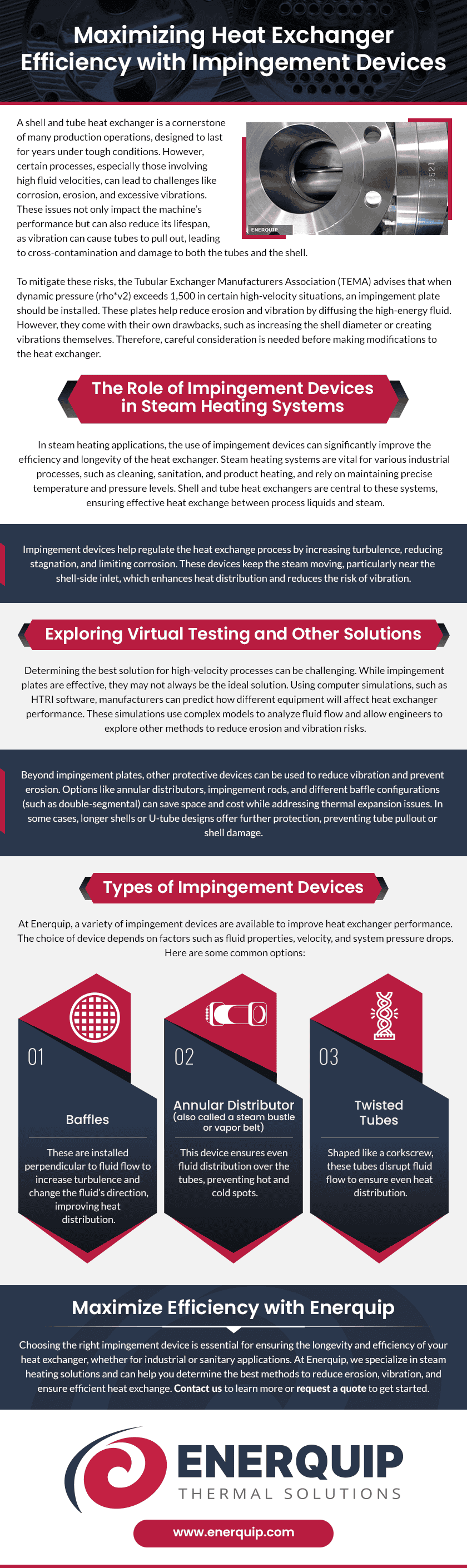
  9. Maximizing Heat Exchanger Efficiency with Impingement Devices

    Comments Off on Maximizing Heat Exchanger Efficiency with Impingement Devices

    Click to Expand

    Maximizing Heat Exchanger Efficiency with Impingement Devices

    A shell and tube heat exchanger is a cornerstone of many production operations, designed to last for years under tough conditions. However, certain processes, especially those involving high fluid velocities, can lead to challenges like corrosion, erosion, and excessive vibrations. These issues not only impact the machine’s performance but can also reduce its lifespan, as vibration can cause tubes to pull out, leading to cross-contamination and damage to both the tubes and the shell.

    To mitigate these risks, the Tubular Exchanger Manufacturers Association (TEMA) advises that when dynamic pressure (rho*v2) exceeds 1,500 in certain high-velocity situations, an impingement plate should be installed. These plates help reduce erosion and vibration by diffusing the high-energy fluid. However, they come with their own drawbacks, such as increasing the shell diameter or creating vibrations themselves. Therefore, careful consideration is needed before making modifications to the heat exchanger.

    The Role of Impingement Devices in Steam Heating Systems

    In steam heating applications, the use of impingement devices can significantly improve the efficiency and longevity of the heat exchanger. Steam heating systems are vital for various industrial processes, such as cleaning, sanitation, and product heating, and rely on maintaining precise temperature and pressure levels. Shell and tube heat exchangers are central to these systems, ensuring effective heat exchange between process liquids and steam.

    Impingement devices help regulate the heat exchange process by increasing turbulence, reducing stagnation, and limiting corrosion. These devices keep the steam moving, particularly near the shell-side inlet, which enhances heat distribution and reduces the risk of vibration.

    Exploring Virtual Testing and Other Solutions

    Determining the best solution for high-velocity processes can be challenging. While impingement plates are effective, they may not always be the ideal solution. Using computer simulations, such as HTRI software, manufacturers can predict how different equipment will affect heat exchanger performance. These simulations use complex models to analyze fluid flow and allow engineers to explore other methods to reduce erosion and vibration risks.

    Beyond impingement plates, other protective devices can be used to reduce vibration and prevent erosion. Options like annular distributors, impingement rods, and different baffle configurations (such as double-segmental) can save space and cost while addressing thermal expansion issues. In some cases, longer shells or U-tube designs offer further protection, preventing tube pullout or shell damage.

    Types of Impingement Devices

    At Enerquip, a variety of impingement devices are available to improve heat exchanger performance. The choice of device depends on factors such as fluid properties, velocity, and system pressure drops. Here are some common options:

    1. Baffles

    Installed perpendicular to fluid flow, baffles increase turbulence and redirect the fluid to improve heat distribution across the tube bundle.

    2. Annular Distributor (steam bustle, vapor belt)

    This device wraps around the outside of the tubes and distributes steam or vapor evenly across the bundle. It’s especially useful in applications where product has the potential to bake onto the tubes, as it prevents hot spots and promotes uniform heating. Learn more.

    3. Steam Dome

    Incorporated into the steam inlet nozzle, the steam dome is an larger nozzle where steam spreads out before reaching the tubes. The steam dome (with or without an impingement plate) helps ensure even steam distribution, minimizes pressure drop, and keeps viscous or sensitive fluids flowing smoothly—reducing the risk of localized overheating or product degradation.

    4. Twisted Tubes

    Shaped like a corkscrew, twisted tubes create controlled turbulence as fluid flows through, enhancing heat transfer and reducing the likelihood of fouling.

    Maximize Efficiency with Enerquip

    Choosing the right impingement device is essential for ensuring the longevity and efficiency of your heat exchanger, whether for industrial or sanitary applications. At Enerquip, we specialize in steam heating solutions and can help you determine the best methods to reduce erosion, vibration, and ensure efficient heat exchange. Contact us to learn more or request a quote to get started.


    More from the Enerquip Blog

  10. Choosing Between a Straight Tube and U-Tube Heat Exchanger Design

    Comments Off on Choosing Between a Straight Tube and U-Tube Heat Exchanger Design

    Designing a Shell and Tube Heat Exchanger

    Designing a shell and tube heat exchanger involves considering various factors, such as cost, application, and facility limitations. A key decision in this process is choosing between a straight tube and a U-tube exchanger. The tube design is crucial; selecting an inappropriate design can lead to exchanger damage or fouling, which is hard to clean. Both designs are widely used across industries like food and beverage, chemical, and pharmaceuticals, each with its own pros and cons.

    The Tubular Exchanger Manufacturers Association (TEMA) classifies exchangers into types, with the BEU model (U-tube design) and the BEM model (straight tube design) being the most common. These models are identical except for the tube design and the rear bonnet. The B-type front bonnet allows access to the tube sheet for cleaning after removal from the piping and is relatively inexpensive. The E-type shell is a popular single-pass design.

    Straight Tube Design
    Straight tube shell and tube heat exchangers from Enerquip

    Advantages of a Straight-Tube Design

    The straight tube design, particularly the BEM model, is simple and versatile, suitable for nearly any industry and application. Some companies may prefer other models for higher efficiency, but the BEM design often works as a substitute.

    Straight tube exchangers enable pure countercurrent flow, usually without needing a second exchanger in series. In such cases, an F-type two-pass shell with a longitudinal baffle is preferred over the E-type, as the baffle separates the two streams. Countercurrent flow means the hot and cold streams move in opposite directions, ensuring the hot stream is always warmer than the cold stream throughout the exchanger.

    In contrast, cocurrent flow involves the hot and cold streams moving in the same direction, requiring the cold stream to always be cooler than the hot stream. This configuration is less efficient, so many manufacturers avoid it.

    Cleaning is another key consideration. Straight tubes are the easiest to clean due to their lack of bends. However, some designs make inspecting and cleaning the shell difficult because the tubes cannot be removed from the shell.

    U Tube Shell & Tube Heat Exchanger by Enerquip
    U-tube shell and tube heat exchanger from Enerquip

    Advantages of a U-Tube Design

    While straight tube designs have many benefits, they can be limited in certain areas, making the U-tube design popular. Although U-tubes involve bending, they require only one tube sheet and bonnet, significantly reducing costs.

    Straight tubes are susceptible to damage from thermal expansion, as tubes heating at different rates can harm the tube sheet and shell. An expansion joint can mitigate this issue, but it adds cost. U-tube exchangers, connected to the tube sheet and shell at only one end, allow for thermal expansion without damaging the rest of the machine.

    U-tube designs also facilitate easy removal of tube bundles for inspection and cleaning of the shell and the outside of the tube bundle.

    If you have questions about the most suitable type of exchanger for your application, contact the experts at Enerquip for advice on the best option to meet your needs.