Comments Off on We Hope to See You at the 14th Annual National Aboveground Storage Tank Conference & Trade Show
On December 1-2, 2021, American Heating Company, an Enerquip company, will be exhibiting at this year’s National Aboveground Storage Tank Trade Show in The Woodlands, TX.
The event is sponsored by the National Institute of Storage Tank Management, a non-profit organization provides educational opportunities and resources related to regulating, managing, and operating underground and aboveground storage tank systems.
NISTM National Conference & Trade Show 2021
The conference is specifically designed for those involved with operations, construction, environmental compliance, spill prevention, and management associated with storage tanks. The upcoming NISTM conference and trade show will keep you current on the latest industry trends, while also connecting you to suppliers and other business partners.
Topics included in this year’s event include:
Recent legislation changes
Corrosion prevention
Tank maintenance and problem prevention tactics
New innovative technology to support your business
Increasing productivity while reducing costs
And so much more.
Get To Know American Heating Company at This Year’s NISTM Conference!
Not only will you take away tons of valuable information from the conference, but the trade show will put you up close and personal with industry partners.
Comments Off on Why Excel Engineering Chooses Enerquip [Video]
Tim Tolley, Principal of Process Engineering at Excel Engineering, shares why he’s been choosing to work with Enerquip since 1997. “In the 24 years that I’ve been using your equipment, there has not been one piece of equipment that has ever had to be replaced,” says Tim Tolley.
Comments Off on Enerquip Employee Match Supports Driftsplitters Snowmobile Club
As part of its employee match program, Enerquip has proudly donated $500 to the Driftsplitters Snowmobile Club. The donation was presented at the organization’s October meeting and will be used for ongoing trail development, grooming, and other enhancements in the Kennan and Catawba areas of Price County.
Enerquip is committed to supporting and encouraging its employees to lift others through giving and service. Therefore, Enerquip provides gifts to organizations at 100% of the employee’s contribution up to $500 per employee per calendar year, including volunteer hours.
This match from Enerquip CNC Machinist Charlie Williams includes his volunteer hours as a member of the Driftsplitters Snowmobile Club.
Enerquip Cares
Learn more about Enerquip’s Community Giving programs.
Comments Off on Questions to Ask When Buying Thermal Fluid Heaters & Heating Systems
When it comes to purchasing industrial heating equipment, most plant managers have a lot on their minds. Deciding whether to purchase new equipment or repair the old equipment, choosing between new and used heaters, selecting an industrial heating equipment provider, establishing a budget for the investment in new equipment… the list goes on and on.
Many times, all of these choices need to be made quickly. Often, the time to invest in new equipment comes unexpectedly when the current piece of equipment has failed. Every day you spend deliberating is a day that your facility spends operating at less than full capacity.
At Enerquip, we’re experts on thermal fluid heaters. We’ve established ourselves as leaders in the thermal fluid heating industry, and we offer some of the most advanced and efficient technologies on the market. We know thermal fluid heaters inside and out – and we’re willing to put that knowledge and insight to work to help our customers make intelligent purchases for their facilities.
Shopping for a new thermal fluid heater or heating system for your plant? Here is a list of key questions to use as a guide as you are evaluating your options when it comes to thermal oil heaters and industrial heating equipment providers.
Purchasing a New Thermal Fluid Heater for Your Plant? Here Are Some of the Key Questions You Should Ask.
Based on our knowledge of thermal fluid heaters and the industrial heating industry, we’ve assembled a list of key preliminary questions plant managers will want to ask early in the shopping process when in the market to purchase a thermal fluid heater or hot oil heater. These questions will help you to evaluate and begin to narrow down your options so you can choose the heater that’s best suited for your facility.
How long will it take for me to receive the thermal fluid heater and have it installed on location?
Who will be handling the thermal fluid heater installation?
Keep in mind that depending on your situation, some of these questions may or may not be applicable. This list is intended as a question bank to be used as a resource, and not an exhaustive list of all the questions that should be asked during the process of buying a thermal fluid heater.
As you move further along in the thermal fluid heater shopping process, your questions will become more detailed and specialized. This list is a good place to start in the preliminary phase of your search.
Other Tips For Shopping Your Options When Purchasing a Thermal Fluid Heater
In addition to asking the right questions, there are other strategies you can use to make sure the heater you ultimately purchase is the best one for your facility and applications. These strategies include:
Visiting facilities that have implemented the thermal fluid heater you are considering
Seeing how others are utilizing the equipment you are interested in is a great way to get a better understanding of how the thermal fluid heater you’re considering will work for your plant. Plus, you may even get a firsthand account of any issues they’ve run into, any tips they have for increasing efficiency, and feedback about their experience working with the thermal fluid heater provider.
Visiting the heater manufacturer
Once you’ve narrowed down your options a bit, it’s a great idea to visit the heater manufacturers whose products are still on the table, if it’s feasible. You may be able to get an inside look at the products and how they are manufactured, and you’ll develop a closer relationship with the representatives you’ll be working with if you’re able to swing an in-person visit.
Talking to others in your industry
Reach out to other individuals in your industry to find out what’s working – and what isn’t working – for them when it comes to thermal fluid heating systems and heating equipment. If they’re willing to share their experiences and recommendations, their insight can help guide you towards the high-quality heating equipment and manufacturers you’ll be the happiest working with.
Buying A Thermal Fluid Heater Can Be Challenging. At Enerquip, We Help Make It Easier.
In the market for a new thermal fluid heater? Be sure to consider Enerquip (formerly American Heating Company) as one of your options.
As leaders in our field, we’ve been manufacturing some of the most efficient thermal fluid heaters on the market for decades. We serve a variety of industries and can help you find or design a thermal fluid heating solution that will work for your business.
Have questions about our thermal fluid heating products? Don’t hesitate to reach out to us! Simply give us a call at (833) 516-6888 or contact us online and we’ll be happy to provide you with the information you’re looking for!
Interested in additional resources for plant managers shopping for thermal fluid heaters? The following resources are a great place to start:
Industrial Heating System Component FAQs – Here, our industrial heating experts answer frequently asked questions about the all the different heating system components your facility relies on, including tank heating coils, heat exchangers, steam generators, and waste heat economizers.
Comments Off on Mechanical Reasons to Choose a Serpentine Coil Heater Over a Helical Coil Heater
If you’re in the market for a new thermal fluid heater, you’ve probably been doing some research to explore and understand your options when it comes to industrial coil heaters.
You have likely learned that many industrial coil heater manufacturers, including Enerquip, produce and distribute helical coil heaters. But while these may be the most common coil heaters on the market, they may not be the best option for a variety of applications.
In addition to offering process benefits, thermal fluid heaters that feature serpentine coils also offer a number of mechanical advantages. If you are preparing to invest in a new industrial coil heater, this is important information to be aware of.
4 Mechanical Benefits of Serpentine Coil Heaters
Thermal fluid heaters that feature serpentine coils set themselves apart from helical coil heaters in a number of ways. Here, we’ll address four of the key mechanical benefits that serpentine coil heaters have to offer.
1. Coil Replacement
Coil replacement in serpentine industrial coil heaters is notably easier than coil replacement in helical coil heaters. With serpentine coil thermal fluid heaters, you can replace one tube at a time instead of replacing the entire coil. This can save you thousands of dollars on the cost of purchasing a new helical coil in its entirety.
Because the coil replacement can be taken care of quickly, you’ll also save hundreds of thousands of dollars by avoiding excess facility downtime.
2. Coil Design
Helical coils experience thermal expansion in all directions. As a result, helical coils fatigue over time, which can cause tube failure or loss of efficiency.
Because of the use of return bends in serpentine coil design, serpentine coils experience thermal expansion in one direction within the confines of the radiant section. As a result, they typically last longer and work more efficiently than helical coils.
In most cases, helical coils and serpentine coils in industrial coil heaters use Sch. 40 tubes. However, because of the bending process used in manufacturing a helical coil, the actual tube wall thickness of a helical coil is considerably less than Sch. 40 in parts of the coil, weakening the tube. This is not the case with a serpentine coil.
4. Combustion Volume
Serpentine coils allow for a larger combustion volume in the radiant section than helical coils. As a result, radiant chamber temperatures in serpentine coil heaters are lower than those in helical coil heaters. This means that coils and insulation in serpentine coil heaters have longer lives than those in helical coil heaters.
Understanding the Differences Between Serpentine and Helical Coil Heaters
Purchasing a new industrial coil heater for your facility is a big investment. It’s important to gather as much information as you can so you can choose the coil heater that’s right for your organization.
Comments Off on Join AHC at the 2021 ILTA Conference in Houston, TX This October
In just a few short weeks, the International Liquid Terminals Association will host the 2021 edition of its annual conference and trade show, happening this year in Houston, TX.
American Heating Company is proud to announce that we will be in attendance – and we hope to see you there!
About the 2021 ILTA Conference & Trade Show
This popular industry event, which brings together thousands of professionals in the tank terminal industry, will be held October 4 – 6, 2021 at the Marriott Marquis Houston. The annual golf tournament affiliated with the conference will be held the day before the conference begins, on October 3.
Now in its 41st year, the ILTA Conference & Trade Show is the largest event of its kind in North America, making it a tremendous opportunity for executives, decision-makers, buyers and industry professionals to network, learn, and make key connections.
2021 ILTA Conference Sessions
This year’s conference features a number of tracks, including ones specifically geared towards professional development, industry executives, environmental concerns, and more.
You’ll have the chance to hear industry cornerstone topics covered by some favorite past presenters. Additionally, based on feedback and suggestions from past attendees, fresh content and new speakers have been added to this year’s line up to ensure that a wide array of topics are covered.
From the keynotes to the break-out sessions, the 2021 ILTA conference is sure to be a great source of information and inspiration for those working in various capacities within the tank terminal industry.
2021 ILTA Trade Show
This year’s ILTA trade show will take place on October 5 and 6. It will feature hundreds of exhibitors – including American Heating Company – involved in aboveground storage tank and terminal operations showcasing their products and services, all in one place!
If you’re shopping for new equipment, looking to connect with new suppliers, or just want to explore new possibilities and business connections, this is the place to do it.
This year, you can find us at booth 716 of the ILTA Trade Show. Be sure to stop by to learn about how our American-made thermal fluid heaters and industrial heating system components can help your facility run efficiently and profitably. Interested in a quote for a piece of custom machinery? We can help with that too!
Connect with American Heating Company at ILTA 2021
If you’re looking to learn more about the industry and stay up to date with the latest and greatest going on in the liquid terminal industry – plus have the opportunity to see products and equipment from top industry vendors in person – attending this year’s ILTA conference and trade show is a must!
As one of the earliest members of the International Liquid Terminals Association, we’ve been participating in the ILTA conference for more than 25 years. We are thrilled to be attending this year’s event, and look forward to seeing you there!
Want to connect with us at ILTA 2021? You can find us at booth 716 at the trade show!
You can also set up a meeting with us ahead of time by giving us a call at 715-748-5888, or send us a message online to get the conversation started.
Comments Off on 10 Key Advantages of Thermal Fluid Heaters
Shopping your options when it comes to industrial heating systems? There’s a lot to carefully consider when you’re upgrading or replacing your facility’s equipment, especially since new heating equipment is a hefty investment.
You want to be sure you’re making the right choice for your facility, both for now and for the long run.
Curious about which will work best for your facility? Although steam systems are still in place in many plants and facilities, the truth is that thermal fluid heating systems are the better way to go for a plethora of reasons.
Here, we review 10 key advantages of thermal fluid heaters and heating systems so you’re armed with information as you continue shopping your options.
Thermal Fluid Heater Advantages
There are a number of benefits that set thermal fluid heating systems apart from the systems they compete with. In fact, hot oil heaters boast advantages in most categories.
Some of these notable advantages of thermal fluid heaters include:
Thermal fluid heaters are highly efficient, and significantly more efficient than their alternative heating system counterparts. They offer facilities the opportunity for decreased operating costs and decreased energy costs (which can contribute, in turn, to increased profitability), while being more environmentally friendly.
2. Installation Flexibility
Whether you’re retrofitting or working with facility constraints, finding the space needed to install a new industrial heating system can be a challenge. Some system types may be eliminated from the running because they can’t be configured within the space available.
Thermal fluid heating systems provide increased installation flexibility. Systems can be installed indoors or outdoors, and in some cases can be built to fit unique specifications. Because they don’t need to be immediately adjacent to the process they are heating, thermal fluid heaters can also be installed remotely. This flexibility is key when you’re working with limited floor space within your facility but you’re still looking for a highly efficient heating solution.
3. Minimal Maintenance
One of the major day-to-day advantages of thermal fluid heaters is the fact that they require minimal maintenance to keep them in prime operating condition compared to steam boiler systems. While they do need housekeeping and attention on a regular schedule for optimal performance, the effort required is not nearly as hefty as what’s required for steam-based systems.
4. Lower Operational Costs
Because they operate efficiently, require minimal maintenance, and don’t necessitate chemical treatment, condensation collection systems, a dedicated system attendant, etc. to operate, thermal fluid heaters boast lower operational costs than steam boiler systems and many other types of process heating systems.
5. Fewer Operational Headaches
As mentioned previously, thermal fluid heaters do not require steam traps, condensation systems, chemical treatments, or blow down maintenance. Additionally, thermal fluid will not freeze in cold temperatures and it is not corrosive. For these and numerous other reasons, thermal fluid heaters produce fewer operational headaches for facility managers on a regular basis.
6. Fewer Staff Requirements
Industry regulations necessitate that a specialized engineer or licensed operator be on hand when some process heating equipment that relies on steam boilers is being operated. As a result, facilities that utilize this type of equipment tend to have additional staff requirements.
This is an additional expense, and can present an additional challenge when it comes to facility operations.
Typically, there are fewer staff requirements associated with thermal fluid heating equipment. (Rules and regulations do change, so be sure you are familiar with the current codes applicable to your industry.)
7. Versatility
Thermal fluid heaters are incredibly versatile and can be used effectively in a variety of processes and industries. They can also replace steam systems in many instances, and they can be installed in a variety of formats to suit the needs and layout of a specific facility.
This versatility is beneficial on a number of levels and is another key reason why thermal fluid heating systems have become a top choice among those shopping their process heating options.
8. No Need for Pressurization
Heating systems that rely on steam require pressure in order to function. This is not the case with hot oil heating systems, which are non-pressurized.
Because thermal fluid heaters don’t require pressurization, they reduce the risk of explosions and eliminate the need for constant regulation and monitoring of system pressure levels. This is a hugely helpful advantage for facilities in a wide variety of industries, and a key reason why hot oil heat is often the better option when compared to steam boilers.
9. No Need for Chemical Regulation
Water is required to make steam, but because water is a corrosive liquid it must be treated with various chemicals when used within steam heating systems. Like pressurization, chemical levels must be closely monitored and regulated to ensure that the heating system is operating effectively.
Thermal fluid heaters eliminate the need for chemical regulation entirely. They rely on thermal heating fluid, which requires no chemical regulation – another advantage that puts hot oil heaters ahead of their steam boiler competitors.
10. No Freezing in Cold Temperatures
Again, when comparing hot oil heaters to steam boilers, the hot oil heaters offer an advantage in that they don’t have the potential to freeze up in cold weather.
Thermal heating fluid will not freeze, which makes freezing temperatures a non-issue for this type of heating system. This eliminates safety hazards and operational issues that could occur in facilities relying on steam heat.
BONUS Advantages of Serpentine Coil Thermal Fluid Heater from Enerquip
In addition to providing the benefits above, thermal fluid heating equipment from Enerquip also offers the following advantages to facilities and plant managers:
Increased Efficiency
It’s true that thermal fluid heaters are more efficient than other types of process heaters, but our state of the art serpentine coil thermal fluid heaters are 10-15% more efficient than standard thermal fluid heaters that utilize helical coils.
This increased efficiency combined with a competitive price point means that one of our thermal fluid heaters can often pay for itself in a little more than one year when replacing an older, inefficient unit.
Longer Lifespans
Our heaters are designed to outlast those of other manufacturers. Built with high quality materials here in the USA, our thermal fluid heaters are some of the most durable, longest-lasting on the market.
The unique serpentine coil design we utilize allows for longer tube life, lower levels of fluid degradation, and efficient operation. Additionally, our heaters make maintenance and repairs easy. As a result, many of our heaters are 20-30 years old and still in operation!
Easy Maintenance & Repairs
Your Enerquip heater should not need repair often, but when and if it does, the repairs can be handled faster and more easily than those required by helical coil heaters. This means less facility downtime and less costly investment in replacement equipment – a win win for your plant.
Typical hot oil heaters can achieve high temperatures at low pressure, but most still offer limited operation at fluid temperatures over 400°F. Our serpentine coil thermal fluid heaters can operate efficiently at temperatures up to 650°F.
Lower Level of Fluid Degradation
Despite operating at higher temperatures, our innovative style of thermal fluid heater provides a lower level of fluid degradation. This makes our heaters increasingly cost effective and efficient.
Longer Tube Life
The serpentine coils in our thermal fluid heaters typically last two to three times longer than standard helical coils. This means your heater will run efficiently for longer, saving your facility money and you the headache of frequent replacements and repairs.
Take Advantage of the Benefits of Thermal Fluid Heaters
Thermal fluid heaters outperform steam boiler systems and other process heating equipment systems while providing these – and other – advantages to the facilities and plant managers that implement them. If you’re looking to replace or upgrade your equipment, a thermal fluid heater is the way to go.
Interested in learning more about how thermal fluid heating equipment can benefit your facility specifically? Give us a call today at (715) 748-5888 or contact us online and we’d be happy to chat with you about how you can put our equipment to work for your business.
Comments Off on Thermal Fluid System Safety: How To Reduce Hazards & Keep Your Plant Safe
No matter what industry you work in, facility safety should be of utmost importance to your organization.
For industries that require the use of high power industrial heating equipment, facility safety can be an extra challenge. The dangers and risks of working with large-scale equipment can be intimidating.
Luckily, there are a number of straightforward ways you can reduce hazards and keep your facility safe when you are working with thermal fluid systems.
Thermal Fluid System Safety Tips
Accidents can and do happen, but even following basic safety tips can help to prevent them. Here, we’ll cover some of the most basic things you can do to keep your equipment in good working condition and your facility safe.
Inspect Your Thermal Fluid System Regularly
Keeping an eye out for signs that a larger problem may be imminent is incredibly important. If you notice something slightly amiss, take action before that small issue grows into a larger problem that could put you and your fellow employees in danger. You should also be sure to have your thermal fluid system inspected by a licensed professional at least once a year.
This is something that should be done as a thermal fluid system is being installed. Ensuring that every single aspect of the system is compatible and can effectively work together is imperative. Incompatible components can create problems and pose safety risks that would not otherwise be present.
Industrial thermal fluid heating systems can be very expensive and it may be tempting to select a less expensive alternative to the highest quality system. Remember – in most cases, it is well worth it to invest in high quality equipment that is engineered by experienced experts and constructed of high quality materials. The equipment will likely last longer and perform better.
Ensure All Employees are Qualified and Properly Trained
Proper employee training can go a long way – especially when it comes to safety. Making sure that every employee working with or in the vicinity of your facility’s industrial heating equipment is trained in safety protocol and knows how to do his or her job correctly is absolutely imperative. By hiring qualified employees, you can reduce the number of mistakes that could lead to accidents.
Replace Your Thermal Fluid System When Necessary
Thermal fluid system replacement seems like a daunting task, but when it needs to be done it needs to be done. While it may mean shutting your facility down for a period of time, replacing your industrial heating equipment when it’s reached the end of its useful life is incredibly important – and it’s definitely preferable over having an accident occur at your plant.
Worn, outdated equipment is more likely to fail, making it a dangerous safety hazard. Investing in new industrial heating equipment can give you the opportunity to upgrade in terms of safety, as well as efficiency. (Learn more about the benefits of efficient plant heating here.)
Make Thermal Fluid System Safety a Priority in Your Facility
Working with high-powered industrial heating equipment can be dangerous, but it doesn’t have to be. When it comes to safety, don’t take any shortcuts and keep these easy safety tips in mind.
Think it might be time to replace your thermal fluid system? Check out the following resources for valuable insight to help you determine the right next steps for your facility.
Factors to Consider When Shopping for an Industrial Heating System – Preparing to shop your options for a new heating system or system component? We’ve put together a list of the top things to consider when you’re in the market for new industrial heating equipment.
Choosing a Thermal Fluid Heater Manufacturer – Industrial heating equipment is a sizable investment. Learn about the key qualities to look for in a thermal fluid heater manufacturer so you can buy confidently from a provider you know you can trust.
Editor’s note: This content was originally published in May 2017 but has been updated as of September 2021.
Comments Off on Double Tube Sheet Design: Importance and Applications
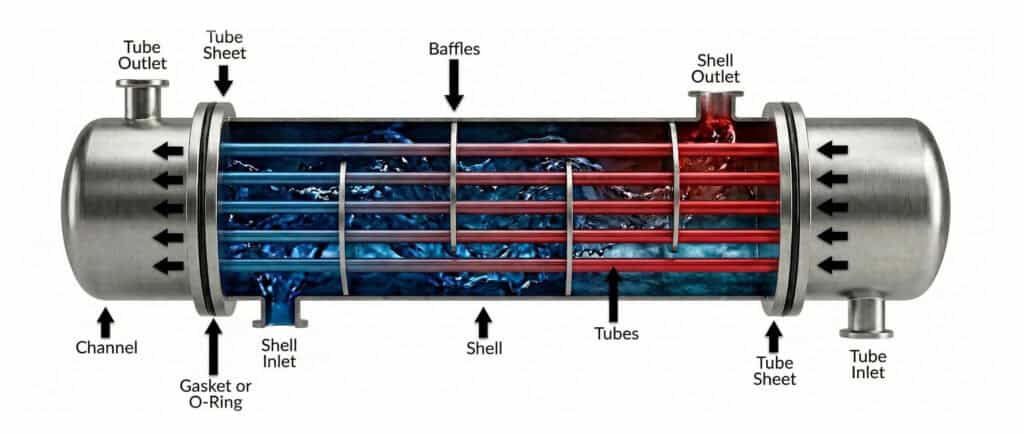
Shell and tube heat exchangers stand out as one of the most popular types of heat exchangers used in industry today. Renowned for their versatility, ease of maintenance, and availability in a range of sizes, they cater to diverse applications.
In the process of choosing the ideal configuration for a shell and tube heat exchanger, factors such as temperature, pressure, and the nature of the processing fluid come into play. Design considerations encompass choices like straight or U-tube arrangements, single or double tube sheets, as well as options between fabricated or machined channels. In the following discussion, we’ll delve into the nuances of tube sheet selections.
The Function of a Tube Sheet
Tube sheets are round, flat plates made from a variety of materials including stainless steel, duplex, AL6XN and Hastelloy. Their primary function is to support and isolate the tubing. Since tube sheets are in contact with both fluids on the shell side and the tube side, they must have corrosion resistance and be sealed tightly to prevent fluids from gaining contact.
At Enerquip, each tube is roller-expanded into grooved tube sheets. Typically, tube sheets less than 1.5” thick receive single sealing grooves and those thicker are double-grooved. The tube-to-tube sheet joints can also include seal welding or strength welding when requested.
Once the tubes are in place, the tube sheet face is polished (if required) to the specified finish for enhanced stability and contamination prevention.
Single Tube Sheet vs. Double Tube Sheet
Every exchanger will have the option of a single tube sheet or double tube sheets.
In a single tube sheet design, the tubes are expanded and sometimes seal welded into one tube sheet that is held between the bonnet and shell flange. If there is a leak between the tube sheet and the tubes, cross-contamination of the process and utility fluids could occur.
In a double tube sheet design, a second outer tube sheet is added to further seal and separate the tubes and the shell. The gap between the tube sheets allows for differential radial thermal expansion, minimizing stress on the tube-to-tube sheet expansions. In the event of a leak in a tube-to-tube sheet joint, shell-side or tube-side fluids would flow out into the gap between the two tube sheets, instead of the leak causing cross-contamination issues. Leaks can also be easily detected and fixed sooner.
Enerquip exchangers are fabricated using multiple measures to ensure proper hygienic design and production. As a standard, pharma-grade exchangers are designed with double tube sheets to minimize the risk of cross-contamination of process fluids between the shell and tubes.
Pharmaceutical units also include roller expanding and seal welding of the tube-to-tube sheet joints on the face of the outer tube sheet per ASME BPE. The roller-expanded and seal-welded surfaces are then polished to the specified finish for all the wetted surfaces.
Double Tube Sheet Design Applications
Double tube sheets are crucial for the safe operation of many heat exchanger applications. In recent years, power plant condensers have even made use of double tube sheet designs. And water treatment facilities use double tube sheets to prevent contamination of their treated and demineralized water from the raw water they used in their condenser steam space.
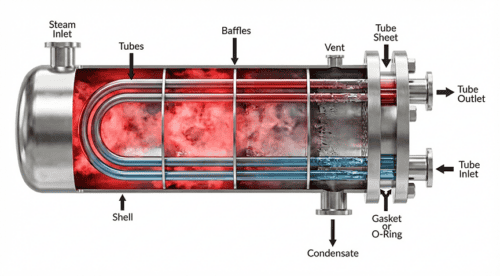
Both straight tube and U-tube style heat exchangers can utilize the double tube sheet design for added safety and security.
Straight Tube
This type of heat exchanger uses tube sheets that are either welded directly to the shell or floating inside the shell. In a welded construction, an expansion joint may be necessary to allow for differential thermal expansion between the tubes and shell.
U-Tube
As the name indicates, the tubes inside the shell are U-shaped. The tubes start at the top of the tube sheet, make a U-shaped bend, then come back to the bottom. The U-tube design does not require an expansion joint because the tube bundle is free to expand or contract.
The ability of thermal regulating equipment like heat exchangers, condensers, and immersion heaters to heat and cool substances efficiently and safely, make them an indispensable tool in industrial processes. Choosing the right equipment to fit your production operations will help greatly in ensuring your process and product quality.
In the market for a custom thermal solution? Our team of experts can design and engineer customized solutions specific to your production needs. Contact us today.
Comments Off on Enerquip Employee Match Supports St. Peter & Paul Catholic Church
As part of its employee match program, Enerquip has proudly donated $500 to St. Peter & Paul Catholic Church in Gilman. The donation was presented at the church’s annual Bazaar and will be used for ongoing outreach and service expenses related to the dedicated work of the church.
Enerquip is committed to supporting and encouraging its employees to lift others through giving and servicing. Therefore, Enerquip provides gifts to organizations at 100% of the employee’s contribution up to $500 per employee per calendar year, including volunteer hours.
This match from Enerquip Design Engineer Linda Olejnichak includes her volunteer hours as the church’s Bazaar Chairperson, along with other volunteer activities.
Enerquip Cares
Learn more about Enerquip’s Community Giving programs.
Enerquip Thermal Solutions uses cookies to give you a more personalized experience on our website. If you continue to use our services, we assume that you accept such use. Learn more about cookies and how you can refuse them on our Privacy Policy page.

 Based on our knowledge of thermal fluid heaters and the industrial heating industry, we’ve assembled a list of key preliminary questions plant managers will want to ask early in the shopping process when in the market to purchase a thermal fluid heater or hot oil heater. These questions will help you to evaluate and begin to narrow down your options so you can choose the heater that’s best suited for your facility.
 Though they are less common, serpentine coil heaters are an ideal option for organizations in a variety of industries.