Skip to Content
Exit

Author Archives: Enerquip

  1. How to Choose an Industrial Heating Equipment Provider (and Why So Many Choose Enerquip)

    Comments Off on How to Choose an Industrial Heating Equipment Provider (and Why So Many Choose Enerquip)

    When it comes to thermal fluid heaters and industrial heating systems, not all providers—or equipment—are created equal. Choosing the right partner can mean the difference between years of trouble-free performance or costly breakdowns and inefficiencies.

    So how do you make the right choice? It helps to understand what really matters when evaluating an industrial heating equipment supplier. Here’s what to look for—and why so many facilities trust Enerquip for their heating needs.

    10 Reasons Facilities Trust Enerquip for Industrial Heating Solutions

    There are many factors that influence a facility’s choice of industrial heating equipment provider. Here are just a few of the factors that have led clients to select Enerquip.

    1. We Offer Standard Models and Custom Solutions

    Whether you need a quick-turnaround solution or something built to your exact specs, Enerquip has you covered. Our standard industrial heating equipment offers reliable performance, faster lead times, and cost-efficiency—perfect for common applications. When your process calls for something more specific, our custom-built systems are engineered to match your exact needs, from temperature and flow requirements to space constraints and code compliance.

    Find out if you should be considering custom equipment for your plant or facility.

    2. Our Equipment Is Built to Last

    Engineered with high-quality materials, Enerquip heaters regularly deliver 20–30 years of reliable service with minimal downtime.

    Learn more about why our thermal fluid heaters last longer than others on the market.

    3. We Offer Competitive Pricing

    Despite offering premium quality and durability, our pricing stays competitive—because long-term value shouldn’t cost a premium.

    4. We Build for Maximum Efficiency

    Our standard heaters use serpentine coil technology, offering superior heat transfer, higher operating temps, and easier maintenance compared to traditional helical coils.

    Learn more about our innovative serpentine coil technology. 

    5. On-Time Delivery is Our Standard

    In an industry where delays are common, Enerquip is known for consistent, reliable lead times. We often deliver faster than customers expect—or even need.

    6. Decades of Industry Experience

    With 30+ years of heating system expertise, our team understands your challenges and speaks your language—whatever your industry.

    Learn more about us.

    7. Compliance with Safety & Quality Standards

    Enerquip designs and manufactures to meet strict ASME Code and other industry standards, so you’re always audit-ready and protected.

    Learn more about the ASME Code and equipment standards we adhere to.

    8. Minimal Maintenance by Design

    Our heaters are designed to reduce the need for frequent service. And when maintenance is required, our systems are built for fast, accessible repairs.

    Learn more about efficient thermal fluid heater repairs with Enerquip heating equipment. 

    9. Made in the USA

    All Enerquip equipment is designed, engineered, and manufactured in the U.S.—ensuring better support, faster delivery, and reliable domestic quality.

    Learn more about the benefits of American made industrial heating equipment. 

    10. A Full Line of Industrial Heating Products

    From thermal fluid heaters to complete heating systems and aftermarket parts, Enerquip is a single-source provider for all your industrial heating needs.

    Learn more about the benefits of shopping for all of your industrial heating equipment needs in one place.

    Don’t Just Pick a Vendor—Choose a Long-Term Partner

    Choosing an industrial heating equipment provider isn’t just about price or specs—it’s about long-term performance, safety, and support. Enerquip checks every box, with a proven track record of delivering high-efficiency, long-lasting systems backed by expert service. Contact us today.

  2. 5 Smart Maintenance Tips to Keep Your Shell & Tube Heat Exchanger Performing at Its Best

    Comments Off on 5 Smart Maintenance Tips to Keep Your Shell & Tube Heat Exchanger Performing at Its Best

    Whether you’re in the middle of a busy production season or just wrapping up a cleaning cycle, one thing’s for sure: keeping your heat exchanger in top shape should always be on your radar. A well-maintained unit runs more efficiently, lasts longer, and helps you avoid costly downtime or product contamination.

    So, what does smart maintenance actually look like for a shell and tube heat exchanger? Let’s break it down with five practical tips you can apply year-round.

    1. Schedule Routine Maintenance (and Stick to It)

    Heat exchanger maintenance usually means taking the equipment offline—so yes, it can feel like a disruption. But planning ahead makes a huge difference.

    • Pick a date during lower production periods.
    • Order gaskets or replacement tube bundles well in advance.
    • Coordinate with contractors early—don’t wait until their calendars are full.

    Skipping scheduled maintenance often leads to bigger problems later. Either you plan the downtime, or the downtime picks you. Spoiler alert: the latter is never convenient.

    2. Keep an Eye on Fouling and Corrosion

    A fouled exchanger is a slow exchanger. Material buildup reduces heat transfer, invites corrosion, and in worst-case scenarios, becomes a fire risk. Inspect regularly—both the tube side and the shell side—for signs of scaling, sediment, or corrosion.

    If you catch fouling early, cleaning is quicker, easier, and less disruptive.

    3. Monitor Your Heat Transfer Fluid (HTF)

    Chemical-based HTFs don’t last forever. Over time, they degrade, lose efficiency, and can even become hazardous.

    To stay ahead of issues:

    • Test the fluid while the system is running (hot fluid tells a truer story than cooled samples).
    • Take samples from different points in the system.
    • Consider quarterly testing for consistent insight into fluid health.

    Healthy fluid means better performance and a lower risk of costly issues.

    Test the fluid periodically; Processing Magazine noted that quarterly testing typically provides the best results.

    4. Bring the Right People to the Table

    Maintenance is a team effort. Involve your safety team, maintenance crew, and contractors from the beginning.

    • Use checklists to stay organized.
    • Share documentation in advance—like safety policies, maintenance logs, and OEM manuals.
    • Require credentials and training records from any outside vendors.

    Clear communication ensures your maintenance day goes smoothly, safely, and efficiently.

    5. Don’t Skip the Post-Cleaning Details

    Once you’re done cleaning, finish strong:

    • Rinse out leftover chemicals or debris—especially after chemical cleaning.
    • Inspect gaskets and gasket covers. Replacements are inexpensive, but failures aren’t.
    • Document what was done and note any issues to watch going forward.

    This final step is easy to overlook but critical for protecting product quality and keeping the exchanger sealed tight.

    Keep Your Equipment (and Your Business) Running Smoothly

    Routine maintenance might not be glamorous, but it’s one of the smartest investments you can make in your operation. Want help planning your next maintenance cycle, ordering spare parts, or upgrading your equipment?

    The heat exchanger pros at Enerquip are here to help—contact us anytime.

  3. Enerquip Donates $500 to Driftsplitters Snowmobile Club

    Comments Off on Enerquip Donates $500 to Driftsplitters Snowmobile Club

    Enerquip is proud to announce a $500 donation to the Driftsplitters Snowmobile Club, made through its Employee Match Program. The donation, presented at the organization’s spring meeting, will support trail development, grooming, and other improvements in the Kennan and Catawba areas of Price County.

    At Enerquip, supporting the causes our employees care about is part of our culture. Through the Employee Match Program, Enerquip matches employee contributions — including financial donations and volunteer hours — 100%, up to $500 per employee each calendar year.

    This contribution was matched in recognition of volunteer hours served by Charlie Williams, an Enerquip CNC Machinist who recently retired and is an active member of the Driftsplitters Snowmobile Club.

    Learn more about Enerquip’s community giving programs here.

  4. Enerquip to Exhibit at 2025 ILTA Conference & Trade Show in Houston

    Comments Off on Enerquip to Exhibit at 2025 ILTA Conference & Trade Show in Houston

    Enerquip is thrilled to announce our participation in the 2025 International Liquid Terminals Association (ILTA) Conference & Trade Show, taking place June 9–11 at the George R. Brown Convention Center in Houston, Texas.

    The ILTA Conference & Trade Show is the premier event for the liquid terminal industry, bringing together over 4,500 professionals and featuring more than 320 exhibitors. Attendees can look forward to a robust program, including 28 conference sessions across four tracks, led by over 50 expert speakers. Keynote addresses will be delivered by Carly Fiorina, former Chair and CEO of Hewlett-Packard, and Admiral James Stavridis, former Supreme Allied Commander of NATO.

    Enerquip will be showcasing our latest innovations in tank heating and heat transfer equipment. Our team is eager to connect with industry professionals to discuss how our custom-engineered solutions can enhance operational efficiency and safety in liquid terminal operations.

    We invite you to visit our booth (#1721) to learn more about how Enerquip’s solutions can meet your facility’s specific needs. Our experts will be on hand to provide insights and answer any questions you may have.

    For more information about the ILTA 2025 Conference & Trade Show, including registration details, please visit the official event website: ilta2025.ilta.org

    We look forward to seeing you in Houston!

  5. Enerquip Supports Spirit Lakes with $1,500 Donation

    Comments Off on Enerquip Supports Spirit Lakes with $1,500 Donation

    Enerquip is proud to back the Spirit Lakes Improvement Association in Rib Lake, WI, with a $1,500 contribution through its Employee Match Program.

    The donation will support efforts to maintain the natural beauty, water quality, and fish habitats of North Spirit Lake and Spirit Lake—ensuring these special places remain a source of pride and enjoyment for the community for years to come.

    Enerquip’s Employee Match Program matches team members’ financial gifts and volunteer hours 1:1, up to $500 annually. It’s one way the company encourages employees to give back to causes they care about.

    This donation was driven by Enerquip team members Troy Weik, Sales & Channel Manager; Trent Weik, Plant Foreman; and Tim Strebig, Operations & Facilities Manager—all of whom serve as board members of the Spirit Lakes Improvement Association and contributed through the program.

    Learn more about the Spirit Lakes Improvement Association at www.spiritlakeassoc.org.

  6. How Almost Any Industry Can Benefit from Waste Heat Recovery

    Comments Off on How Almost Any Industry Can Benefit from Waste Heat Recovery

    In a world where energy costs keep rising and sustainability expectations are higher than ever, waste heat recovery has become a smart — and surprisingly simple — way for facilities of all types to lower operating expenses, boost efficiency, and shrink their environmental footprint.

    What is Waste Heat Recovery?

    Waste heat recovery is the process of capturing heat that would otherwise escape into the air or environment and putting it to good use elsewhere — whether it’s preheating water, powering additional processes, or even generating electricity. It’s like giving your energy a second life instead of letting it slip away.

    While nearly any large-scale operation can benefit, certain sectors are leading the charge by investing heavily in waste heat recovery systems. Let’s take a closer look at where these systems are making a serious impact — and why your facility might be next.

    Industries Benefiting from Waste Heat Recovery

    1. Oil, Gas, and Fuel Refining

    Refining crude oil into fuel is one of the most energy-hungry industrial processes out there. Operations like distillation, cracking, and treatment generate intense amounts of heat. Waste heat recovery systems help refiners reuse that energy — reducing fuel consumption, cutting emissions, and improving overall plant efficiency.

    2. Cement and Building Materials

    The cement industry, famous for its massive kilns operating at up to 400°C, has seen a sharp rise in waste heat recovery adoption. Capturing heat from kiln exhaust not only slashes energy costs but also helps facilities meet tightening emissions regulations — a win-win for both profits and the planet.

    3. Food and Beverage Production

    Whether it’s cooking, pasteurization, or bottling, food and beverage plants generate plenty of excess heat. Many smart food processors have embraced waste heat recovery, using systems like Enerquip shell and tube heat exchangers to reroute and reuse energy throughout their facilities — improving sustainability and cutting costs along the way.

    4. Colleges, Universities, and Large Campuses

    Higher education institutions aren’t just teaching sustainability — they’re practicing it. Universities are installing heat exchangers and economizers to recover wasted energy from campus utilities, saving tens of thousands in energy bills and millions of gallons of water annually.

    5. Chemical and Pharmaceutical Manufacturing

    Precise temperature control is essential in chemical and pharma production. Waste heat recovery systems not only stabilize processes but also lower utility costs by capturing and reusing heat that would otherwise be lost in reactors, dryers, and condensers.

    6. Data Centers and Technology Hubs

    Those racks of servers aren’t just producing information — they’re generating a ton of heat. Forward-thinking data centers are now using waste heat recovery to heat office spaces, nearby buildings, or even entire city blocks, turning a liability into an asset.

    7. Pulp, Paper, and Packaging Industries

    Steam is king in pulp and paper plants. Capturing waste heat from steam vents and dryers can provide significant energy savings and help offset the high energy demands of paper production.

    Why Waste Heat Recovery Matters More Than Ever

    No matter the industry, one fact is clear: making the most of the energy you already produce is a powerful way to stay competitive. Waste heat recovery can:

    • Cut fuel and utility costs significantly
    • Boost overall energy efficiency
    • Reduce greenhouse gas emissions
    • Extend the life of existing equipment
    • Support corporate sustainability initiatives

    Ready to Put Your Waste Heat to Work?

    If you think your facility might be leaking valuable heat (hint: it probably is), the experienced engineers at Enerquip are ready to help. We’ll work with you to design the right shell and tube heat exchanger or waste heat economizer solution to capture, redirect, and reuse your energy for maximum efficiency.

    Reach out today — because saving money (and the planet) never goes out of style.

  7. New vs. Used Thermal Fluid Heating Systems: Weighing Your Options

    Comments Off on New vs. Used Thermal Fluid Heating Systems: Weighing Your Options

    4 Reasons to Invest in New Thermal Fluid Heating Equipment

    Industrial heating equipment isn’t cheap. And if you’ve ever had a system malfunction out of the blue, you know that replacing it can be a major hit to your budget — and your stress levels.

    It’s no wonder some facility managers consider buying used industrial heating equipment when budgets are tight. In some cases, it’s the right call. But more often than not, investing in new heating equipment is the smarter, more cost-effective choice.

    At Enerquip, we believe new is almost always the better way to go. Not just because of the risks tied to used systems, but because of the many benefits that new equipment brings to your operation, including those below.

    1. Rock-Solid Reliability

    If you’re shopping for a new thermal fluid heating system, chances are your old one isn’t cutting it anymore. Whether it failed completely or is limping along, you need a replacement you can trust.

    A new heating system gives you peace of mind. No guessing games, no crossed fingers. It’s built fresh to fit your facility’s needs and ready to help you get back up and running fast.

    2. Longer Lifespan

    Used equipment comes with baggage as it’s already logged some hard miles. That means it has less usable life left for your facility.

    Sure, the upfront cost of used equipment might be easier to swallow. But if it needs replacing again sooner than later, are you really saving anything?

    If longevity is important (and it should be), new equipment is the way to go. Our thermal fluid heaters, for example, are some of the longest-lasting options on the market. They’re ready to support your operation for years to come.

    3. True Affordability

    Buying used might feel like a bargain at first. But hidden costs can pile up fast: more maintenance, more downtime, and a quicker need for a second replacement.

    When you add it all up, new equipment often wins out in total cost of ownership. It’s a bigger investment upfront, but one that pays off with fewer headaches (and fewer invoices) down the road.

    4. Latest Technology

    Technology doesn’t sit still, and neither should your plant.

    When you invest in new equipment, you get the latest advancements in efficiency, safety, reliability, and sustainability. Features that didn’t even exist a few years ago could now give you a competitive edge.

    Buying new helps future-proof your facility, letting you stay ahead of both the curve and the competition.

    In the Market for a New Thermal Fluid Heater?

    If you’re weighing your options between new and used industrial heating systems, think long term. Used might help today’s budget, but new can deliver more value, and fewer surprises, tomorrow.

    At Enerquip, we specialize in thermal fluid heaters and other industrial process equipment. With decades of experience, we’re ready to help you design the perfect solution for your facility. Contact us today.


    More from the Enerquip Blog

    When to Replace Your Thermal Oil Heating System

    Factors to Consider When Shopping for an Industrial Heating System

    Key Benefits of Low NOx Thermal Fluid Heaters

    Why Your Hot Oil Heater is Burning Up Your Heating Fluid

    Serpentine vs. Helical Coil Heaters: Understanding the Differences

    Why More Facilities Are Turning to Hot Oil Heating Systems Over Steam Boilers

  8. What to Expect When Purchasing Thermal Fluid Heating Equipment from Enerquip

    Comments Off on What to Expect When Purchasing Thermal Fluid Heating Equipment from Enerquip

    At Enerquip, we’ve spent decades building high-quality, American-made thermal fluid heaters and heating systems. Our equipment powers operations across industries — and we take just as much pride in the strong relationships we’ve built with our customers as we do in the equipment we craft.

    We get it: Choosing and purchasing industrial heating equipment can feel overwhelming. There’s a lot to consider, and it’s a big investment. That’s why we work hard to make the process as easy, transparent, and stress-free as possible.

    If you’re considering upgrading your facility’s heating system, here’s what you can expect when you work with Enerquip.

    The Enerquip Purchase Process: Step-by-Step

    Because no two projects are exactly alike, we tailor each purchase process to our customers’ needs. But generally, here’s the flow you can expect:

    1. Do Your Research

    Most equipment purchases start with some good old-fashioned research. We invite you to:

    Not sure what questions you should be asking? No worries — we’ve got a handy list of questions to help guide you.

    2. Request a Quote

    Once you’ve found a system (or two) that piques your interest, request a quote. We’ll gather your specifications and provide a detailed breakdown so you can see exactly what to expect — no surprises.

    3. Select the Right Equipment

    If you’re ready to move forward, we’ll work closely with you to fine-tune your equipment selection. Need something fully-customized? No problem — we specialize in custom builds based on your specifications.

    4. Confirm the Purchase

    Next, we’ll:

    • Review all the project details with you
    • Confirm your equipment specifications
    • Finalize the purchase with a Purchase Order (PO)
    • Outline payment terms (typically progress payments as your unit is built)

    This step ensures everything is crystal clear before we dive into manufacturing.

    5. Manufacture Your Equipment

    Once we have your PO in hand, our team gets to work. We offer a range of proven standard solutions to keep things efficient and on schedule — but when your project calls for it, we’re fully equipped to customize your equipment to meet your specific needs. Every unit we build upholds the high standards of quality and performance Enerquip is known for.

    6. Delivery

    Finally, it’s delivery day! Our delivery timelines vary depending on your project, but we’re known for meeting — and often beating — deadlines. When timing matters (and it always does), Enerquip delivers.

    Why Choose Enerquip?

    We believe buying industrial heating equipment shouldn’t be a headache. When you work with Enerquip, you get:

    • Decades of experience across a wide range of industries
    • Made-in-the-USA quality you can count on
    • Straightforward, responsive communication every step of the way
    • Reliable delivery timelines that keep your project on track

    Have questions? We’re here for them. Whether you want to pick up the phone, send us a quick message, or browse our blog at your own pace, we’re ready to help you make an informed decision.

    Ready to get started? Request a quote today or call us at (833) 516-6888 to chat about your facility’s heating needs.

    Helpful Resources

    Looking for more insights before you buy? Check out these helpful articles:

  9. How to Close Out Sugaring Season on a Sweet Note

    Comments Off on How to Close Out Sugaring Season on a Sweet Note

    As the days grow warmer and trees start to bud, maple sugaring season winds down. The steady flow of sap slows as nighttime temperatures stay above freezing, and the changing trees trigger a chemical shift that can turn the sap bitter. When this happens, it’s time for syrup producers to wrap up operations and start planning for next year.

    A successful sugaring season starts with proper end-of-season maintenance. Here’s how to ensure your maple syrup production is in top shape when the next season rolls around.

    1. Inspect and Maintain Your Equipment

    Maple syrup production relies on specialized equipment, from spiles and buckets to evaporators and heat exchangers. Before packing everything away, take time to inspect each piece. Check for cracks, warping, rust, or any other damage that could affect performance next year.

    Pay special attention to shell and tube heat exchangers, which play a critical role in achieving the perfect syrup consistency and ensuring food safety. If anything needs replacing, now is the time—waiting until next season could leave you scrambling.

    2. Evaluate Your Tappable Trees

    High-quality syrup starts with healthy trees. Walk through your sugar bush to assess your maple trees, noting any that are dead, diseased, or damaged. Trees infested with insects or those producing lower-quality sap should be retired. Removing weaker trees allows healthier ones to thrive, ultimately improving your yield.

    3. Clean Up for a Fresh Start

    Maple syrup production is naturally sticky business. Sap, sugar residue, and outdoor debris can accumulate on equipment throughout the season. To keep everything in peak condition, thoroughly clean all tools, tanks, and tubing.

    Use hot water as your primary cleaning agent—soaps and detergents can leave behind unwanted flavors that may taint next year’s syrup. For deeper sanitation, refer to manufacturer recommendations for safe and effective cleaning solutions.

    Looking Ahead

    While it’s always a little bittersweet to see the season end, it’s also the start of another important phase—bottling, selling, and enjoying the fruits of your labor. Proper maintenance now ensures a smoother, more productive sugaring season next year.

    If you’re in the market for new equipment or need guidance on maintaining your shell and tube heat exchangers, the heat transfer experts at Enerquip are here to help. Get in touch to keep your operation running efficiently for seasons to come.

    More from the Enerquip Blog

    Maple Syrup Producers Use Heat Exchangers to Improve Production

    Tube Side or Shell Side: Comparing Fluid Allocation Options for Your Shell and Tube Heat Exchanger

    How Static Mixers & Turbulators Improve Heat Exchanger Efficiency

    Honey Warming Prevents Crystallization

    How Shell and Tube Heat Exchangers Benefit the Agriculture Industry

    Unique Process Conditions for Plant-Based Milk Production

  10. Helical vs. Serpentine: What’s the Best Way to Build an Industrial Hot Oil Heater?

    Comments Off on Helical vs. Serpentine: What’s the Best Way to Build an Industrial Hot Oil Heater?

    When it comes to designing industrial hot oil heaters, one question pops up time and again:
    Should you choose a helical coil or a serpentine coil?

    As longtime designers and manufacturers of high-performance thermal fluid systems, we know the answer makes a big difference in heater efficiency, longevity, and maintenance. Here’s a breakdown of both designs—and why Enerquip stands firmly behind the serpentine coil.

    Helical Coil Heaters: Traditional but Less Efficient

    Helical Coil HeaterThe helical coil design has been an industry standard for years. In this style, tightly wound coils are stacked within the radiant section of the heater (marked as A in the graphic), where heat transfers to the fluid through radiation on the inner surface of the tubes.
    In the convection section (B), heat transfer occurs only on the outer surface, which limits overall efficiency.

    Because of their tightly grouped coils, helical designs leave little room for thermal expansion. This can make repairs more difficult and lead to more frequent fluid degradation—especially at high temperatures. It’s not uncommon for stack temps to exceed 800°F, and the design typically limits operation above 400°F.

    While widely used, this setup can become a maintenance headache over time.

    Serpentine Coil Heaters: Enerquip’s Go-To Design

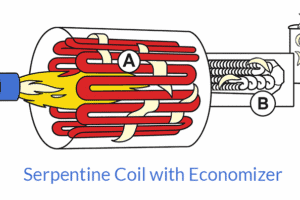
    At Enerquip, we do things differently. Our standard hot oil heaters feature a serpentine coil design—and for good reason.

    Enerquip Serpentine Coil Thermal Fluid Heater

    In the radiant section (A), the spaced-out coils allow heat to reach the front, back, and sides of each tube. This improves heat transfer and reduces hot spots. In the convection section (B), more surface area is exposed, keeping stack temperatures lower and extending heater life.

    This design not only improves thermal efficiency but also results in:

    • Less fluid degradation
    • Longer tube life
    • Simpler maintenance

    That’s why we’ve made serpentine coil heaters the Enerquip standard—and why we encourage customers to consider this smarter, more efficient option.

    Want to Learn More?

    If you’re in the market for a new hot oil heater—or just doing your homework—here are some helpful resources to dig deeper:

    Whether you’re replacing an old unit or planning your next system upgrade, our team is here to help you choose the right design—built to last and perform.

    Call us at (833) 516-6888 or request a quote to get started.