Skip to Content
Exit

Author Archives: Enerquip

  1. The Case for Waste Heat Recovery: Why Your Facility Shouldn’t Ignore It

    Comments Off on The Case for Waste Heat Recovery: Why Your Facility Shouldn’t Ignore It

    Enerquip Economizer for Recovering Waste Heat

    Thinking about adding a waste heat recovery unit to your heating system but still on the fence? While every industrial facility has unique needs, one thing remains constant—waste heat recovery is a smart investment. By capturing and repurposing excess heat, your facility can boost efficiency, cut costs, and reduce environmental impact.

    If you’re not utilizing waste heat recovery yet, here’s why you should be.

    1. Boost Efficiency & Maximize Output

    Efficiency is the cornerstone of any well-run operation. Industrial heating systems consume vast amounts of energy, and much of that heat is wasted. A waste heat recovery unit captures this excess heat and puts it to work, improving your system’s overall efficiency.

    Whether it’s preheating process fluids, generating steam, or supplementing another heat source, recycling waste heat helps your facility do more with less.

    2. Slash Energy Consumption

    Every bit of wasted heat represents lost energy—and lost money. With a waste heat economizer in place, your facility can:

    • Reduce the amount of fuel needed to maintain operations
    • Lower overall energy consumption
    • Conserve valuable resources

    This translates to lower utility bills and a more sustainable operation.

    3. Cut Operating Costs

    For plant managers looking to reduce expenses, waste heat recovery is a game-changer. By reusing heat that would otherwise be lost, you reduce the need for additional fuel sources—saving money without sacrificing performance.

    A properly designed waste heat recovery system pays for itself over time through reduced energy costs, making it one of the most effective ways to improve your facility’s bottom line.

    4. Reduce Waste & Emissions

    Industrial facilities are under increasing pressure to minimize emissions and reduce their environmental impact. Waste heat recovery helps by:

    • Cutting down on greenhouse gas emissions
    • Reducing overall fuel consumption
    • Lowering air pollutants and carbon footprint

    In some cases, a well-integrated waste heat recovery unit can eliminate the need for an additional heat source altogether, further improving sustainability.

    Invest in Waste Heat Recovery for Long-Term Benefits

    If you’re looking for a cost-effective way to enhance efficiency, lower expenses, and reduce emissions, implementing a waste heat recovery unit is a smart, long-term investment.

    Explore these additional resources to see how waste heat recovery can benefit your facility:

    Got questions? Give us a call at (833) 516-6888 or contact us here. Our team has decades of experience designing, manufacturing, and installing industrial heating solutions. We’re here to help you make the best choice for your facility.

    More from the Enerquip Blog

    Is Landfill Gas a Renewable Energy Source?

    Plastic Pyrolysis: Transforming Waste into Resources

    Exploring Electrolysis as a Leading Hydrogen Production Process

    Decoding the Delicate Balance of Sizing Shell and Tube Heat Exchangers
    How Economizers Enhance Thermal Oxidizers

  2. Maple Syrup Producers Use Heat Exchangers to Improve Production

    Comments Off on Maple Syrup Producers Use Heat Exchangers to Improve Production

    The Science and Innovation Behind Maple Syrup Production

    Maple syrup is a beloved topping for pancakes, waffles, and countless other treats. While its rich, sweet flavor remains timeless, the process of making maple syrup is constantly evolving. Producers have a limited window each year to harvest sap and transform it into syrup, making efficiency and innovation key to success.

    The Fleeting Sugaring Season

    Sugaring season begins when winter transitions into spring, creating warm days and freezing nights. This temperature fluctuation causes sap to flow from maple trees, a process that continues until nighttime temperatures remain above freezing and buds begin to form. Once the sap becomes bitter, the season comes to an end.

    Since weather patterns shift annually, sugaring season can vary in duration. An early spring may lead to an early start, while a sudden warm spell can shorten the season significantly. Because of this unpredictability, syrup producers must work quickly and efficiently to maximize their yield.

    Speeding Up the Sap Production Process

    To make the most of sugaring season, producers have developed innovative methods to speed up and refine the syrup-making process. One such approach involves using indirect heat systems to accelerate evaporation. Some producers employ steam-craft technology to pre-boil the sap, significantly reducing the time needed for evaporation compared to traditional direct-heat methods.

    Many producers also use sanitary shell and tube heat exchangers to pasteurize syrup, making it less viscous and easier to bottle while removing potential contaminants. Another widely adopted method is reverse osmosis (RO), which concentrates the sap before it enters the evaporator. RO technology improves efficiency by reducing the time and energy needed for evaporation, allowing producers to decrease fuel consumption while maintaining syrup quality.

    Saving Energy During Syrup Production

    Since syrup production is consolidated into a several-week-long sprint, condensed operations demand high energy spend. While more syrup producers are utilizing RO technology, there are other ways producers can save energy.

    A large amount of water needs to be removed from sap to make syrup. Because of this, the syrup-making process gives off incredible amounts of steam. The steam released provides a convenient and free heat source that producers are beginning to take advantage of.

    By installing a shell and tube heat exchanger, syrup manufacturers can capture the heat lost to rising steam and use it to preheat the sap before it reaches the evaporator. Like RO, this process will reduce the amount of time the sap needs to spend in the evaporator before it reaches the desired consistency.

    This mechanism was perfected in 1974 by George Raithby of the University of Waterloo in Ontario. Prior to Raithby’s development, the use of any equipment above the evaporator would compromise the final product because rising steam would condense on the metal surface and drip back into the open pans of syrup. Raithby used a shell and tube heat exchanger with a drip pan installed beneath it to collect the condensate. Inside the tubes, the sap could be heated from a starting temperature of about 40 degrees Fahrenheit to around 190 degrees Fahrenheit before it reaches the evaporator.

    Today, modern stainless steel heat exchangers continue to enhance durability and performance in maple syrup production.

    Making the Most of Sugaring Season

    Sugaring season may be short, but its impact is long-lasting for both producers and syrup lovers alike. Innovations in heat transfer technology, reverse osmosis, and energy efficiency help producers optimize their operations and ensure a steady supply of high-quality syrup. If you’re looking to improve your syrup production process, consider investing in a shell and tube heat exchanger. Reach out to the engineers at Enerquip to explore how this technology can enhance your operation.


    From the Enerquip Blog

    Tube Side or Shell Side: Comparing Fluid Allocation Options for Your Shell and Tube Heat Exchanger

    How Static Mixers & Turbulators Improve Heat Exchanger Efficiency

    3 Shell & Tube Heat Exchanger Features That Affect Shell-Side Pressure Drop

    Shell and Tube Heat Exchangers: A Guide to Industry Standards

    Selecting Tube Sizing in a Shell and Tube Heat Exchanger

  3. 5 Thermal Design Considerations for Personal Care Manufacturers

    Comments Off on 5 Thermal Design Considerations for Personal Care Manufacturers

    Click to Expand

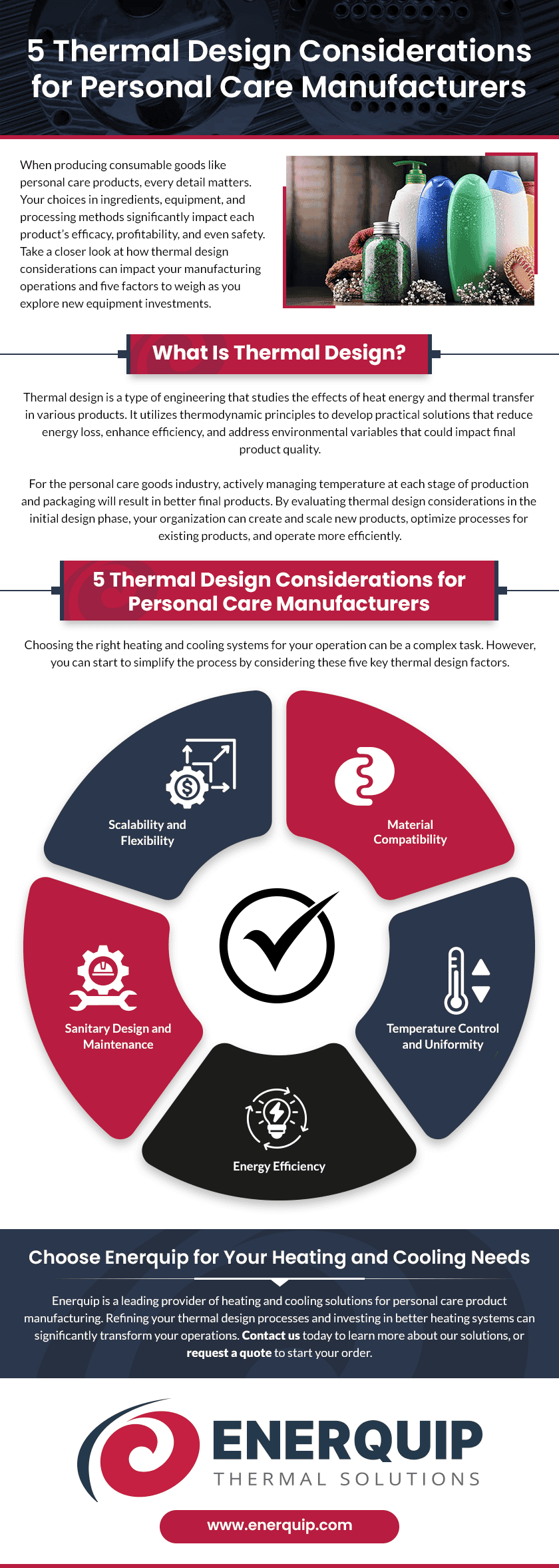
    5 Thermal Design Considerations for Personal Care Manufacturers

    When producing consumable goods like personal care products, every detail matters. Your choices in ingredients, equipment, and processing methods significantly impact each product’s efficacy, profitability, and even safety. Take a closer look at how thermal design considerations can impact your manufacturing operations and five factors to weigh as you explore new equipment investments.

    What Is Thermal Design?

    Thermal design is a type of engineering that studies the effects of heat energy and thermal transfer in various products. It utilizes thermodynamic principles to develop practical solutions that reduce energy loss, enhance efficiency, and address environmental variables that could impact final product quality.

    For the personal care goods industry, actively managing temperature at each stage of production and packaging will result in better final products. By evaluating thermal design considerations in the initial design phase, your organization can create and scale new products, optimize processes for existing products, and operate more efficiently.

    5 Thermal Design Considerations for Personal Care Manufacturers

    Choosing the right heating and cooling systems for your operation can be a complex task. However, you can start to simplify the process by considering these five key thermal design factors.

    1. Material Compatibility

    Select processing and temperature control equipment that won’t degrade when in contact with your personal care products, which may contain corrosive ingredients. Invest in stainless steel or other corrosion-resistant materials for your process equipment, so that the equipment does not react with product ingredients or compromise the safety and quality of the product.

    2. Temperature Control and Uniformity

    Personal care goods like ointments, lotions, and oils are temperature-sensitive. If the temperature is too high or the processing system contains hotspots, product ingredients can degrade, discolor, lose potency, or separate. All of these outcomes lead to inconsistent final products and dissatisfied customers. Invest in heat exchangers and heating systems that provide reliable, granular temperature control at all stages of production.

    The following assemblies, in particular, play a key role in heat consistency and control:

    3. Energy Efficiency

    Don’t let process heat go to waste. Investing in heat recovery solutions reduces costs and makes your facility run more energy-efficiently. For instance, heat recovery systems can redirect excess heat from vapor condensers to preheat downstream processes. You can also reconfigure your production systems by identifying and eliminating sources of heat loss, optimizing power efficiency for both heating and cooling systems.

    4. Sanitary Design and Maintenance

    In personal care goods manufacturing, sanitation is a top priority. Products that come into contact with users’ skin or hair must comply with ASME-BPE for cleanliness and hygiene.

    However, contaminants can easily build up in crevices or rough patches of processing equipment. That’s why it’s important to use heating assemblies and heat exchangers with smooth surfaces, seamless tubes and components, and minimal crevices. Also, heating machinery should be easy to inspect and clean.

    5. Scalability and Flexibility

    Finally, invest in heating solutions that can accommodate a wide range of ingredients and product formulations. Demand in the personal care industry is constantly changing as consumers look for new ingredients and formulas that deliver better results. Choose equipment you can easily adapt to produce new goods, scale up production of in-demand products, and accommodate seasonal fluctuations.

    Choose Enerquip for Your Heating and Cooling Needs

    Enerquip is a leading provider of heating and cooling solutions for personal care product manufacturing. Refining your thermal design processes and investing in better heating systems can significantly transform your operations. Contact us today to learn more about our solutions, or request a quote to start your order.

    From the Enerquip Blog

    How to Pressure Test Shell & Tube Heat Exchangers

    Tube Side or Shell Side: Comparing Fluid Allocation Options for Your Shell and Tube Heat Exchanger

    How Static Mixers & Turbulators Improve Heat Exchanger Efficiency

    The Art and Science of Film Temperature to Achieve Goldilocks Efficiency

    Discover the Hidden Brilliance of Metal Surfaces: Unleash the Power of Electropolishing

  4. Why Careful Wastewater Treatment for Breweries Matters

    Comments Off on Why Careful Wastewater Treatment for Breweries Matters

    Sustainable Wastewater Management for Breweries

    Brewing beer is a water-intensive process. Water is not only the primary ingredient in beer but also essential for cleaning, rinsing, and maintaining brewing equipment. On average, breweries use about seven barrels of water for every barrel of beer produced. Even the most water-efficient operations still require around three barrels of water per barrel of beer.

    As sustainability becomes a top priority in every industry, wastewater management is a crucial consideration. Proper wastewater treatment ensures compliance with environmental regulations, reduces costs, and minimizes the ecological impact of brewery operations.

    Addressing Brewery Wastewater Challenges

    Breweries generate wastewater rich in organic materials such as sugars, yeast, and proteins. While these elements are not inherently toxic, they contribute to high biochemical oxygen demand (BOD) levels, which can overwhelm municipal water treatment facilities and disrupt natural ecosystems. Excess nutrients can lead to algae overgrowth in local waterways, negatively affecting aquatic life and water quality.

    Many breweries face the decision of whether to treat wastewater on-site or rely on municipal treatment systems. Some municipalities may not have the capacity to handle brewery wastewater, leading breweries to explore alternative solutions.

    Brewery Wastewater Treatment Solutions

    Breweries have several options for managing wastewater effectively:

    1. Municipal Treatment Partnerships – Some breweries send their wastewater to municipal treatment facilities. However, in cases where local plants lack the capacity to handle high-strength wastewater, breweries must seek alternative treatment methods.
    2. On-Site Wastewater Treatment Systems – Investing in an on-site treatment facility allows breweries to manage their wastewater independently. Many breweries use anaerobic digesters, filtration systems, or other advanced treatment technologies to reduce environmental impact and operating costs.
    3. Resource Recovery – Some breweries partner with wastewater treatment companies that convert wastewater into reusable resources, such as clean water and energy. By treating and repurposing wastewater, breweries can reduce overall water consumption.

    The Role of Heat Exchangers in Wastewater Treatment

    Efficient wastewater treatment often involves temperature regulation. Heat exchangers play a crucial role in stabilizing wastewater temperatures, improving treatment efficiency, and recovering heat for reuse in brewing processes. Shell and tube heat exchangers, for example, help breweries maintain optimal temperatures while reducing energy consumption.

    Minimizing Environmental Impact

    Sustainable wastewater management is vital for breweries looking to minimize their environmental impact and improve operational efficiency. Whether through municipal partnerships, on-site treatment systems, or resource recovery, breweries have multiple options for responsible wastewater management.

    For breweries considering wastewater treatment upgrades, the right equipment is essential. Enerquip’s engineers have extensive experience providing heat exchangers for food and beverage manufacturers. Contact our team to learn how our solutions can support your brewery’s sustainability goals.


    From the Enerquip Blog

    How Annular Distributors Improve Efficiency in Shell and Tube Heat Exchangers

    Choosing a Heat Exchanger For Your Brewing Process

    The Best Types of Shell and Tube Heat Exchangers

    Standards for Sanitary & High-Purity Processing Equipment

    Shell and tube heat exchangers are used to cool wort in craft brewing

    How Do Water Heat Exchangers Work?

    Why New Glarus Brewing Chooses Enerquip

  5. How to Pressure Test Shell & Tube Heat Exchangers

    Comments Off on How to Pressure Test Shell & Tube Heat Exchangers
    Hydrostatic Pressure Testing

    Enerquip shell and tube heat exchanger getting hydrostatic pressure tested before shipment.

    Pressure testing heat exchangers is a critical process to ensure their safety, reliability, and functionality. Strict adherence to procedures is essential to avoid damage to equipment or harm to personnel. While new heat exchangers are pressure tested before shipment, there may be times you need to re-pressure test older units in the field.

    Here, we outline best practices and safety guidelines for conducting pressure tests on heat exchangers.

    What is Hydrostatic Pressure Testing?

    Hydrostatic testing is a vital process for verifying the safety and integrity of pressure vessels. Adhering to ASME Section VIII Division 1, UG-99 standards ensures compliance with the highest industry benchmarks. This testing method verifies that vessels can withstand operational pressures by safely filling them with water and applying pressure to identify leaks, weaknesses, or potential safety hazards.

    General Guidelines for Pressure Testing

    Do Not Exceed Operating Pressures: Always test within the specified operating pressures for the unit. Testing above these pressures can lead to equipment damage or catastrophic failure.

    Special Considerations for Steam on Shell Side: If testing with steam to check for tube leaks, expect steam to exit until the tube side is fully dried. This process must be closely supervised to prevent burns or injuries. Avoid using steam on fixed tube sheet straight tube units, as the heat can cause excessive thermal expansion, resulting in permanent damage.

    Testing One Side at a Time: Empty one side of the heat exchanger and pressurize the other. Monitor for pressure drops, as leaks in testing equipment (connections and valves) can lead to false results.

    Required Materials & Equipment

    Before starting a hydrostatic test, you’ll need the following materials and equipment:

    • Fittings, Blind Flanges, Plugs, & Valves: Ensure these are rated for the required test pressure.
    • Dial Indicating Pressure Gauges: Choose gauges with a range between 1.5 and 4 times the required test pressure, calibrated per the manufacturer’s quality control manual.
    • Digital Reading Pressure Gauges: Use these for greater accuracy and a broader pressure range.

    Step-by-Step Guide to Hydrostatic Testing

    Now that you’ve gathered all the necessary supplies, the following steps will guide you through the process of hydrostatic pressure testing.

    1. Complete Final Weld NDT Tests: Before starting, confirm that all weld non-destructive testing (NDT) is complete. This ensures there are no underlying issues that could compromise the test.
    2. Purge Air Pockets: Install vents at all high points of the vessel to eliminate trapped air during filling. Air pockets can distort pressure readings and compromise test results.
    3. Inspect Equipment: Double-check that all hydro equipment, fittings, blind flanges, and plugs are securely tightened before you start applying pressure. A loose connection can lead to test failure or safety hazards.
    4. Apply Test Pressure: Refer to the applicable vessel drawing to determine the correct test pressure. Be cautious not to exceed 10% above the calculated pressure, as this could damage the vessel or invalidate the test.
    5. Monitor Temperature Requirements: Use water with a temperature of at least 60°F. Ensure the vessel and water temperatures are similar before applying pressure. Keep the metal temperature at least 30°F above the vessel’s minimum design metal temperature. Wait until the vessel cools to below 120°F before conducting any inspections.
    6. Install Calibrated Gauges: Attach a calibrated gauge directly to the vessel. Place a second calibrated gauge near the hydro pump for clear visibility during the test.
    7. Test Multi-Chamber Vessels Separately: For vessels with independent pressure chambers, test each chamber individually, ensuring no pressure is applied to adjacent chambers during the process.
    8. Never Leave the Vessel Unattended: Once the vessel is under test pressure, it must be supervised at all times to ensure immediate response to any issues.
    9. Inspect for Leaks: Conduct a visual inspection of all joints and connections while the vessel is at least two-thirds of the test pressure. Look for visible wetness or drips to identify leaks. Any leaks must be resolved before completing the test.
    10. Drain and Dry the Vessel: After a successful test, fully drain and dry the vessel to prevent corrosion or contamination.

    Safety First

    Hydrostatic testing carries inherent risks, so it’s crucial to follow safety protocols:

    • Test pressure vessels according to their engineering drawings and design specifications.
    • Equip personnel with the proper protective gear.
    • Ensure all team members are trained in hydrostatic testing procedures.

    Confidence in Compliance

    By following these steps, you can confidently conduct hydrostatic testing on heat exchangers and other pressure vessels. This not only guarantees compliance with safety standards but also ensures your equipment is ready to perform under pressure—literally and figuratively.

    Partner with Enerquip for Reliable, High-Performance Heat Exchangers

    At Enerquip, we understand the importance of maintaining safe and efficient operations. Our equipment is designed to meet the highest standards, giving you peace of mind in every operation.

    If you’re ready to optimize your system or explore new heat exchanger options, contact our knowledgeable team. We’re committed to ensuring your process equipment operates at peak performance.

    Contact Us or Request a Quote to learn more!


    More from the Enerquip Blog

  6. Tube Side or Shell Side: Comparing Fluid Allocation Options for Your Shell and Tube Heat Exchanger

    Comments Off on Tube Side or Shell Side: Comparing Fluid Allocation Options for Your Shell and Tube Heat Exchanger

    Every shell and tube heat exchanger operates with two fluids—one flowing through the tubes and the other in the shell. You likely made a careful selection based on the unique needs of your process and the specific properties of each fluid. But deciding where to allocate each fluid is just as important.

    Fluid placement affects heat transfer efficiency, maintenance requirements, and the overall cost of your exchanger and future replacements. To help you make the best decision, ask yourself these five key questions.

    1. Which fluid is more likely to foul?

    Minimizing fouling is a critical goal in any heat exchanger design. Even with preventative measures in place—such as selecting compatible materials and creating effective cleaning schedules—fouling is often inevitable. When it occurs, you want the cleaning process to be as easy and efficient as possible.

    In most cases, the tubes are easier to clean than the shell. For this reason, it’s typically a smart move to place the fluid with a higher fouling potential on the tube side. However, the design of your heat exchanger matters here. For example, U-tube configurations are harder to clean than straight tubes, which could make cleaning the shell side easier in those cases. Evaluating your heat exchanger’s design before deciding will ensure the fouling-prone fluid is in the location that minimizes downtime and maintenance costs.

    2. Which fluid is more corrosive?

    Corroded tubes are easier to replace than a corroded shell.

    Corrosion can take a toll on any system, but some damage is easier and cheaper to address than others. Replacing corroded tubes is typically simpler and less costly than replacing the entire shell, which often requires a full exchanger replacement.

    For this reason, it’s generally better to place more corrosive fluids on the tube side. Additionally, this strategy allows engineers to select different materials for the tubes and shell, using more corrosion-resistant materials where needed without overengineering the entire system.

    Stainless steel tubes often hold up better against corrosive fluids than carbon steel. Selecting the right materials at the design stage can extend the life of your heat exchanger and reduce maintenance expenses.

    3. What states are the fluids in?

    Understanding the physical state of your fluids during operation is essential for efficient allocation.

    • Vapors: Fluids that are or will become vapor should generally be on the shell side due to their larger volume and lower heat-transfer coefficient.
    • Non-condensing vapors: If the vapor won’t condense, it’s often better on the tube side to prevent stagnation in the shell, which can reduce heat transfer efficiency.
    • Fluids prone to solidification: If there’s a chance the fluid could freeze or solidify, it should be on the tube side, where mechanical cleaning or tube replacement is more feasible. Solidified fluids on the shell side could mean extensive downtime or equipment replacement.

    4. Which fluid has the highest pressure?

    Handling high-pressure fluids requires thicker containment walls, which can quickly escalate costs. Since building thicker tubes is more cost-effective than building a thicker shell, the high-pressure fluid should typically be allocated to the tube side.

    This approach not only keeps costs down but also simplifies future repairs, as damaged tubes can be replaced without overhauling the entire system.

    5. How viscous are the fluids?

    Viscous fluids usually have low heat-transfer coefficients, which can negatively impact performance. By placing them on the shell side, you can improve heat transfer efficiency through a staggered tube arrangement, which increases turbulence and enhances heat transfer.

    However, viscous fluids also tend to have a higher pressure drop, creating challenges such as bypassing baffles or causing vibrations. To mitigate these risks, vibration issues should be addressed during the design phase, ensuring long-term operational reliability.

    Smart Fluid Allocation Starts in the Design Phase

    Finding the ideal fluid allocation isn’t always straightforward, especially when conflicting factors arise. For instance, if both fluids would benefit from the shell side, you’ll need to carefully prioritize based on the overall design objectives and maintenance strategies.

    That’s why early planning is key. When you identify your process fluids before the design phase, engineers can create a custom heat exchanger tailored to your specific needs. This approach helps mitigate potential fouling, vibration, or corrosion issues right from the start.

    At Enerquip, our engineers are passionate about problem-solving. When you work with us, you’re not just getting a heat exchanger—you’re getting a team dedicated to helping your system run efficiently and reliably.

    Ready to optimize your process? Contact us today to request a quote and start designing your custom solution.


    More from the Enerquip Blog

  7. Enerquip to Exhibit at the 2025 NISTM Trade Show

    Comments Off on Enerquip to Exhibit at the 2025 NISTM Trade Show

    Enerquip Joins the 2025 NISTM Conference & Trade Show

    Enerquip Thermal Solutions is thrilled to participate in the upcoming NISTM (National Institute for Storage Tank Management) Trade Show, taking place at the Rosen Shingle Creek Hotel at 9939 Universal Blvd in Orlando, FL from April 22 – 24, 2025. The trade show hours are:

    • April 23: 8:30 AM – 5 PM
    • April 24: 9 AM – 1 PM

    Conference Highlights

    The NISTM Trade Show is renowned for bringing together industry experts, decision-makers, and innovators to discuss best practices, regulatory updates, and emerging technologies. Key conference offerings include:

    • Free EPA SPCC & FRP Short Course
    • Tanks 101 Course
    • Liquid Terminals 101 Course
    • Free Aviation Fueling Master Class
    • The full conference program designed to address critical industry needs

    Networking Opportunities

    Expand your professional connections through several events:

    • Golf Tournament: April 22
    • Welcome Reception: April 22
    • Women in the Tanks Industry Networking Event: April 22
    • Network Mixer: April 23

    Visit Enerquip’s Booth

    Our booth will feature a product display and valuable information, offering attendees the chance to:

    Join Us!

    We invite you to visit our booth and discover how Enerquip’s commitment to quality and innovation can benefit your operations. Whether you’re upgrading existing systems or designing new ones, our team is here to help you find customized solutions.

    We look forward to seeing you there!

  8. Enerquip to Exhibit at CheeseCon 2025 in Madison

    Comments Off on Enerquip to Exhibit at CheeseCon 2025 in Madison

    Enerquip to exhibit at CheeseCon 2025 in Madison

    We’re thrilled to announce that Enerquip will be exhibiting at CheeseCon 2025, the premier event for dairy processors and industry innovators, held April 15-17 at the Alliant Energy Center in Madison, Wisconsin. Join us at booth #919 on April 16 to explore the latest advancements in heat transfer technology and how our custom solutions are designed to meet the unique sanitary needs of the dairy industry.

    Why Attend CheeseCon 2025?

    CheeseCon, hosted by the Wisconsin Cheese Makers Association, is more than just a trade show — it’s a hub for networking, education, and discovering innovations that drive the dairy industry forward. With over 3,000 dairy professionals attending and 300+ exhibitors showcasing the latest in equipment, technology, and services, this is an opportunity you don’t want to miss.

    What to Expect at Enerquip’s Booth (#919)

    As a trusted partner for the dairy industry, Enerquip specializes in designing and fabricating high-performance sanitary and 3-A heat exchangers, including CIP heaters, condensers, preheaters, reboilers, process coolers and evaporators, tailored to meet strict industry standards. At our booth, you can:

    • See a Sanitary Heat Exchanger Up Close: Explore the precision engineering behind our heat exchangers and how they optimize production efficiency while meeting stringent sanitary requirements.
    • Meet Our Experts: Our knowledgeable team will be on hand to answer your questions and discuss how our customizable solutions can help your facility maintain optimal performance.
    • Learn About Our Stock & Custom Solutions: Whether you’re expanding production or upgrading existing systems, we’re here to collaborate and design solutions tailored to your process needs.
    Partnering for Quality and Innovation

    Enerquip’s involvement at CheeseCon underscores our commitment to providing innovative solutions that support the dairy industry’s evolving needs. With decades of experience and a dedication to quality, we understand the critical role efficient sanitary equipment plays in producing high-quality dairy products.

    Let’s Connect at CheeseCon 2025

    We’re eager to meet industry professionals, hear your challenges, and discuss how we can support your goals. Visit us at booth #919 and experience firsthand why Enerquip is a trusted partner for dairy processors.

    To learn more about CheeseCon 2025 and register, visit cheesecon.org. We can’t wait to see you there!

  9. Repair or Replace: What’s Best for Your Thermal Oil Heating System?

    Comments Off on Repair or Replace: What’s Best for Your Thermal Oil Heating System?

    When your facility’s thermal oil system falters, the decision to repair or replace it can feel daunting. Making the right choice is critical to ensuring your business runs smoothly and stays profitable.

    A broken heating system can create costly downtime, disrupt productivity, and drain resources. While repairs might seem like the faster fix, they’re often temporary and can lead to recurring issues. On the other hand, replacement is a bigger investment but offers a more permanent solution—one that could save you money and headaches in the long term.

    Let’s take a closer look at the key factors to consider when deciding whether to repair or replace your facility’s thermal oil system.

    Signs It’s Time to Replace Your Thermal Oil System

    After decades of helping plant managers navigate this decision, we’ve identified common signs that replacing your thermal oil system is the better choice. Here’s what to watch for:

    1. Your System is Inefficient

    Efficiency is everything in industrial heating. An inefficient system wastes energy, drives up costs, and impacts sustainability efforts. If your system is outdated and struggling to meet your needs, replacement could drastically improve efficiency and reduce operating expenses over time.

    Learn why efficient industrial heating equipment is so important.

    2. Your System Uses Helical Coils

    Helical coils are a common approach but come with drawbacks, including high maintenance costs. Upgrading to serpentine coil technology offers better heat transfer, easier maintenance, and longer-lasting performance.

    Find out why serpentine coils are the superior choice.

    3. Your System is Unreliable

    An unreliable heating system threatens productivity and profitability. If you’re constantly troubleshooting, repairing multiple components, or facing frequent breakdowns, it’s likely time to invest in a new system.

    Regular maintenance can help extend the life of your equipment. Check out these maintenance tips to keep your system running smoothly.

    4. Your System is Outdated

    Technology evolves quickly, and older systems often lag behind in efficiency and performance. If your equipment is struggling to keep up, replacing it with a modern system could give you a competitive edge.

    Considering a full system update? Here are a few reasons you might want to consider purchasing all the components of the system in one place.

    5. You Want to Boost Long-Term Profitability

    Old systems are costly to maintain and operate. Investing in a new thermal oil heater can increase efficiency and productivity, resulting in long-term cost savings. While there is an initial upfront cost to new equipment, the ROI makes it worth the investment.

    6. Repairs Cost More Than 75% of Replacement

    Depending on what needs to be repaired, thermal oil system component repairs can cost up to 75% of what it would cost for replacement. In those instances, replacement is typically the better investment, because in most cases it provides more value for your spend over time by offering increased efficiency, reliability and profitability in the long run.

    Find out why a new thermal oil heating system is often the best option.

    Addressing Common Concerns About Replacement

    We understand replacing your thermal oil system is a big decision. Here are a few common concerns and how we address them:

    • Downtime: Our team works with facilities to minimize disruptions during installation, ensuring a seamless transition.
    • Cost: While replacement is an investment, it pays off through lower energy costs, reduced downtime, and improved reliability.
    • Complexity: We’ll guide you through every step of the process, from selecting the right system to installation and maintenance.

    Time To Replace Your Thermal Oil Heating System?

    If the time has come to invest in new industrial heating infrastructure for your plant, contact the experts at Enerquip. With years of experience and a commitment to delivering reliable, efficient solutions, we’ll work with you to find the best system for your facility.

    Call us at (833) 516-6888 or request a quote to get the process started – we’ll provide equipment configurations and pricing tailored to your facility.

    Don’t let an outdated system hold your facility back. Invest in efficiency, reliability, and profitability with a new thermal oil heating system today. Let’s build a better future for your plant—together.

    From the Enerquip Blog

  10. Thermal Fluid Heater Repairs: Helical Coil Heaters vs. Serpentine Coil Heaters

    Comments Off on Thermal Fluid Heater Repairs: Helical Coil Heaters vs. Serpentine Coil Heaters

    When it comes to repairing thermal fluid heaters, understanding the differences between helical coil and serpentine coil designs is crucial. Two common repairs—fluid replacement and coil replacement—vary significantly depending on the type of heater. In this post, we’ll also explore how downtime and expenses factor into these repairs, helping you make informed decisions for your facility.

    Common Thermal Fluid Heater Maintenance

    1. Fluid Replacement

    Thermal fluid plays a vital role in your heater’s operation, but over time, it can degrade and require replacement. How frequently this happens depends largely on the design of your heater.

    Helical Coil Heaters: Helical coil heaters often necessitate more frequent fluid replacement. This is due to the higher film temperature compared to the bulk temperature in their design, which accelerates fluid degradation.

    Serpentine Coil Heaters: The radiant coil bundles in serpentine coil heaters provide more even heat distribution. This reduces oil degradation, meaning fluid replacement is required less often compared to helical coil heaters.

    If your heating fluid is causing issues, check out these guides:

    2. Coil Replacement

    The heating coil is the heart of any thermal fluid heater, and its replacement can be a critical (and costly) part of maintenance.

    Helical Coil Heaters: Coil replacement is typically a planned part of helical coil heater maintenance. However, replacing a helical coil is a major undertaking, often requiring several weeks to complete. This process involves significant downtime and expense, as the entire coil generally needs to be replaced.

    Serpentine Coil Heaters: In contrast, serpentine coils are known for their durability. Coil replacement is rarely necessary and, when repairs are needed, they can often be performed while the coils remain in place. This makes repairs quicker and more affordable than those for helical coils.

    Factors to Consider When Repairs Are Necessary

    1. Downtime

    Facility downtime can have a major impact on productivity and revenue.

    Helical Coil Heaters: Repairs to helical coils often require extended downtime, as replacing the entire coil is a complex, time-intensive process. Your facility could face weeks—or even months—of reduced or halted operations.

    Serpentine Coil Heaters: Serpentine coil repairs are far less disruptive. Because the coils can typically be repaired in place, downtime is minimal. With a solid spare parts strategy, you can reduce downtime even further.

    2. Repair Expenses

    The cost of repairs is another critical factor to consider.

    Helical Coil Heaters: Between replacement parts, labor, and lost productivity during downtime, repairing helical coil heaters can be expensive. In some cases, facility managers may find it more economical to replace the system entirely.

    Serpentine Coil Heaters: Repairs for serpentine coil heaters are typically faster and less costly. While still an investment, the shorter downtime and ability to repair in place make them more budget-friendly compared to helical coil repairs.

    Thermal Fluid Heater Repairs on the Horizon? Let’s Talk!

    If your thermal fluid heater needs repairs or replacement, we’re here to help. With decades of experience, we’re experts in evaluating your facility’s needs and providing the best solution—whether that’s repairing your system or investing in a new one.

    We’re proud to manufacture high-quality thermal fluid heaters featuring serpentine coil technology. If you’re considering upgrading your heating system, we’d love to show you how our innovative solutions can save you time and money.

    Give us a call today at (833) 516-6888 or contact us online to learn more about how our heating technology could benefit your business.

    From the Enerquip Blog