Comments Off on Enerquip Boosts Efficiency with New Machining Center
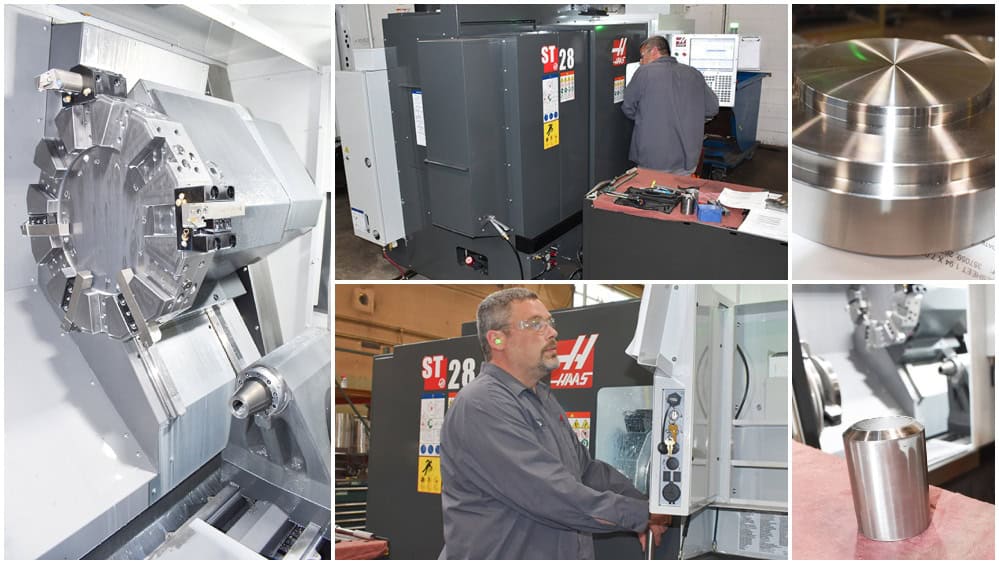
Enerquip Thermal Solutions has taken another step toward greater operational efficiency and manufacturing excellence with the recent addition of a new Haas ST-28 Turning Center at its Medford, WI, facility.
This high-performance machine brings powerful turning capabilities in a compact footprint, making it ideal for high-volume production of small-diameter parts and couplings—components critical to Enerquip’s shell and tube heat exchangers.
“With the ST-28, we’re increasing both our capacity and our speed, especially for the smaller, more repetitive parts that often slow down production when competing for time on our larger machines,” said Tim Strebig, Facilities & Operations Manager at Enerquip. “This means faster turnaround times and better responsiveness to our customers’ needs.”
By dedicating the ST-28 to small-diameter part production, Enerquip can reduce bottlenecks, optimize workflow, and maintain tight tolerances across high-run orders. This upgrade enhances product reliability and supports Enerquip’s mission of delivering high-quality, American-made thermal equipment on time and to spec.
“As demand for our equipment continues to grow across sanitary and industrial markets, this investment helps us stay ahead—ensuring our customers receive on-time delivery of their equipment,” added Strebig.
Enerquip Machinist Kyle Trudell operates the company’s newest CNC machine, a Haas ST-28 Turning Center, designed for high-volume, high-production environments. This new equipment streamlines Enerquip’s production and helps ensure faster turnaround for its customers.
Comments Off on Why Is My Heat Exchanger Flange Leaking? Common Causes & Fixes
Shell and tube heat exchangers are essential to safe, efficient processing—and leaks are never part of the plan. Whether you’re working in food and beverage, chemical, or pharmaceutical manufacturing, even a small leak can trigger big problems: lost productivity, product contamination, environmental hazards, or fire risk.
One common place where leaks show up? The flanges.
Understanding what causes flange leaks—and how to fix them—can help you protect your equipment, your team, and your bottom line.
First, What Is a Flange?
Flanges are the connection points where parts of a heat exchanger are joined together. Each flange includes:
A metal ring (flange face)
A gasket for sealing
Bolts that hold everything in place
When leaks occur at the flange, the gasket is often blamed—but it’s not always the sole culprit. Let’s look at three common causes of flange leaks and how to resolve them.
1. Thermal Stress & Flange Distortion
Heat exchangers are built to handle wide temperature swings—but extreme temperature differentials can still cause metal parts to expand and contract at different rates, leading to flange warping or misalignment. If the differential exceeds around 110°C (230°F), extra precautions should be taken during design or maintenance.
How to prevent distortion-related leaks:
Increase flange and tube sheet thickness
Use more conservative stress values in calculations
Lower the allowable flange rigidity index
Increase the bolt ratio to 120% of the design value and run full bolt-load analysis
Working with a heat exchanger manufacturer who understands your application’s thermal profile is key to preventing temperature-induced failures from the start.
2. Loose or Improperly Torqued Bolts
Heat, vibration, and pressure can all cause bolts to loosen over time—leading to loss of gasket compression and eventual leaks. Retightening bolts is a start, but doing it incorrectly or too frequently may mask a larger issue.
Best practices:
Use proper torquing techniques: hot torquing or hydraulic tensioning are more effective than manual tightening.
Check for excessive paint on bolts: degraded coatings can reduce bolt load over time.
Ensure the design supports proper load distribution and stress handling.
If your flange bolts keep loosening no matter how often you tighten them, you might need to reassess the mechanical design or use hardware that can absorb thermal expansion and pressure cycles better.
3. Inadequate Hardware or Gasket Design
Persistent leaks—even after proper bolt torquing—may indicate a deeper issue with your gasket or hardware setup.
Two effective solutions:
Disc spring washers: These help maintain constant bolt load despite thermal expansion and contraction
Weld ring gaskets: These reinforced gaskets are welded in place, keeping the sealing material contained and preventing deformation or scuffing caused by movement
These types of upgrades help maintain seal integrity over time, especially in systems that see repeated thermal cycling or vibration.
Don’t Ignore the Signs of a Flange Leak
Whether your system is brand new or has been running for years, a flange leak should never be brushed off. It’s often a warning sign of a larger issue—whether it’s stress, improper assembly, or a need for a more robust design.
At Enerquip Thermal Solutions, we’re here to help. Our engineers can review your heat exchanger configuration, identify the root cause of recurring leaks, and recommend the best path forward—whether it’s replacement parts, design tweaks, or new equipment.
Contact us today to troubleshoot flange leaks and keep your system running safely and efficiently.
When it comes to shell and tube heat exchangers, consistency, quality, and performance matter. That’s why the Tubular Exchanger Manufacturers Association (TEMA) developed a comprehensive set of industry standards to guide the design and manufacturing of these systems for a wide range of critical applications.
In this article, we’ll break down what the TEMA standards include, what they mean, and how they’re applied.
About TEMA Heat Exchangers
TEMA brings together industry-leading manufacturers of shell and tube heat exchangers. In creating standards, these key players have determined the important features and functionality for these heat exchangers to operate safely in specified applications. Standards also help ensure that quality and performance are consistent across manufacturers. The standards cover things like tolerances, machining operations, and the design of components used in the heat exchanger assembly.
TEMA Heat Exchanger Specifications
First published in 1941, the current version of TEMA shell and tube heat exchanger standards dates to the 2024 update. Today, most shell and tube exchangers used in high-demand industries around the world still follow these established guidelines.
The standards apply to exchangers with:
Shell diameters up to 60 inches
Design pressures up to 3,000 psi
A combined diameter and pressure value not exceeding 60,000 in-lbs
TEMA also provides guidelines for larger units in its documented Recommended Good Practices.
There are three classifications based on intended use:
Class R: Designed for use in refineries for petroleum processing. These are also often used in large-scale or high-severity industrial applications.
Class C: Intended for general commercial use.
Class B: Developed for chemical processing applications. They are usually made from stainless steel or alloys, which allow for slightly lighter construction in non-critical areas.
TEMA Designations for Shell and Tube Heat Exchangers
In addition to classifications, TEMA documentation also defines several designated types of heat exchangers, based on the combination of front end, shell, and rear end components used.
These three types of components are:
Front-End Head: The exchanger’s inlet and outlet channels, types A, B, C, N, and D.
Shell: The shape and construction of the shell, types E, F, G, H, J, K, and X.
Rear-End Head: Including tube access and thermal expansion capability, types L, M, N, P, S, T, U, and W.
There are multiple designations, each with a different combination of front-end, shell, and rear-end types. It’s important to note that not all designations may be suitable for each TEMA class: the application and use conditions always govern the design options available.
A simple and cost-effective configuration that can be used with single- or multi-pass tube configurations.
With removable heads – AEL, BEM, AEM
With non-removable bonnet and removable covers – NEN
Floating Head and Tube Sheet
These designs allow for easy access to the tubes for cleaning, inspection, and maintenance, and also provide thermal expansion protection without need for an expansion joint.
Removable bundle – AEW, BEW, AES, BES, AET, BET. These designs allow for easy access to the shell side for cleaning/maintenance.
Non-removable bundle – BEP, AEP, NEP
U-Tube
A type of bundle design with maximum thermal expansion capacity. The tubes expand and contract independently from the shell, and the unit can therefore handle greater thermal shock. Most are removable bundles, which allows for easy replacement in case of a tube failure.
Removable bundle – BEU, AEU. The BEU configuration is by far the most common.
Non-removable bundle – NEU, CEU. These are good for high-pressure or harsh process conditions where an all-welded configuration is needed.
Kettle Reboiler
Designed for use in distillation and similar processes. These exchangers vaporize one fluid to heat another, ideal for high-performance chemical and petrochemical processes.
BKU, AKU, AKT
Shell Designations
Note that most designations above include an E style shell – this is a single pass shell, the most common and versatile design. If the thermal process requires it, most of these could be changed to incorporate other shell configurations:
F-shell – Two-pass shell
G/H/J-shell – Split or divided flow
X-shell – Cross flow
K-shell – Kettle type for vaporization
Final Thoughts
TEMA standards bring structure to a complex design world—but they don’t tell you which type of exchanger to choose. That’s where a knowledgeable manufacturer comes in.
At Enerquip, we specialize in sanitary and industrial heat exchangers built to TEMA standards. Our in-house team handles design, fabrication, welding, machining, inspection, and testing—from start to finish. With decades of experience, we can help you select and build the right shell and tube heat exchanger for your unique process.
Comments Off on Enerquip Welcomes Sashank Kali as New Design Engineer
Enerquip Thermal Solutions is pleased to welcome Sashank Kali to its growing team of engineering professionals. Kali joins as a Design Engineer at Enerquip’s headquarters in Medford, Wisconsin, bringing with him a rich blend of global experience, technical talent, and creative passion.
Originally from India, Kali holds a Bachelor of Technology in Mechanical Engineering from Kalinga Institute of Industrial Technology and a Master of Science in Mechanical Engineering from Arizona State University. His academic and professional path has spanned continents and disciplines, from modal analysis and sustainable water treatment research to optimizing heat exchanger and pressure vessel designs using advanced CAD and FEA tools.
Kali’s hands-on experience includes roles at ECCS Corp and Adaptive Concepts LLC, where he refined industrial designs to improve manufacturability and performance. He’s also no stranger to the shop floor, with practical knowledge in CNC machining, 3D printing, and sheet metal fabrication—making him a well-rounded addition to Enerquip’s design team.
“From the moment I spoke with the team, I could tell Enerquip was a place where precision meets purpose,” said Kali. “I was drawn to the company’s culture of collaboration, mentorship, and humility—values that align with my own approach to engineering. I’m excited to contribute to innovative designs that not only perform but genuinely help our customers succeed.”
Kali’s expertise includes 3D modeling and drafting in SolidWorks and AutoCAD, ASME code-compliant pressure vessel design, and structural and thermal simulations in Ansys Workbench and COMSOL. His multidisciplinary background and curiosity-driven mindset make him a strong fit for Enerquip’s mission to deliver smart, reliable thermal solutions.
“Kali brings a strong blend of creativity, curiosity, and technical rigor to the table,” said Cameron Diedrich, Enerquip’s Design Engineering Manager. “We’re confident his fresh perspective and engineering instincts will help us continue to elevate our designs and exceed customer expectations.”
When he’s not solving design challenges, Kali enjoys sketching car concepts, playing guitar, and exploring photography. He credits his artistic hobbies with helping him see engineering problems from new angles—and often, more elegant solutions.
Enerquip looks forward to the contributions Kali will bring as the company continues its commitment to delivering high-performance thermal solutions to customers worldwide.
Comments Off on Why Spare Parts Planning Matters for Your Process Equipment
No matter your industry, if your operation depends on process heating or cooling equipment, it pays to be ready when things don’t go as planned.
If you’ve invested in a reliable thermal fluid heating system or heat exchanger, great news—you’ve already set yourself up for long-term performance. But even the most dependable equipment can face wear and tear, breakdowns, or unexpected issues. And when that happens, you’ll want to be ready to act fast.
The best way to minimize downtime and headaches? A solid spare parts strategy.
Why Stock Spare Parts for Your Thermal Fluid Heater or Heat Exchanger?
Spare parts planning isn’t just for major processors or high-volume operations. It’s a smart move for any facility looking to reduce risk and stay productive. Here’s why having key parts on hand is a no-brainer:
1. Minimize Downtime When Issues Arise
When process equipment goes down, every minute counts. Having replacement parts already onsite means you’re not waiting on shipping or scrambling for a workaround. Whether your in-house team can make the repair or you’re calling in service support, having the right parts available can get you back up and running faster.
2. Get Ahead of Backorders and Discontinued Parts
Some replacement parts—especially for older heating systems—can be tough to track down. Lead times can stretch or parts may be discontinued altogether. By proactively stocking critical components, you can avoid the need for generic or mismatched substitutes that might compromise your equipment’s performance or safety.
3. Lower Emergency Repair Costs
Every unplanned repair brings unexpected costs, from rush shipping to after-hours service. When you already have the part in inventory, you’re one step ahead. You’ve paid for the part, avoided potential markup, and kept the repair focused on labor—not procurement delays.
4. Stay Proactive, Not Reactive
Facilities that run lean or skip spare parts planning often take a reactive approach to maintenance. But having a predictive maintenance mindset—like tracking wear parts and stocking strategic spares—helps you avoid surprise downtime and shows that your team’s thinking long-term.
5. Boost Overall Plant Efficiency
It’s not just about fixing what’s broken. A spare parts program supports smoother maintenance scheduling, reduces unplanned outages, and contributes to better energy use and productivity. In short, it’s a small effort that can have a big impact on your bottom line.
Where to Start with Spare Parts Management
You don’t need to stock every bolt and gasket. Start by identifying the most critical, high-wear, or long-lead-time parts for your thermal fluid heating system or heat exchanger. Partner with your equipment supplier to get a recommended spare parts list and revisit it annually as your system ages or your process changes.
Need help building your list? Our team at Enerquip is happy to help you identify which spare parts are best to keep on hand for your system. Get started.
Comments Off on Vacuum Breakers 101: Small Device, Big Impact on Heat Exchangers
When it comes to keeping your heat exchanger running smoothly, a small device called a vacuum breaker plays a big role. Think of it as a safety valve that prevents your system from turning into a steam-powered implosion.
What Is a Vacuum Breaker?
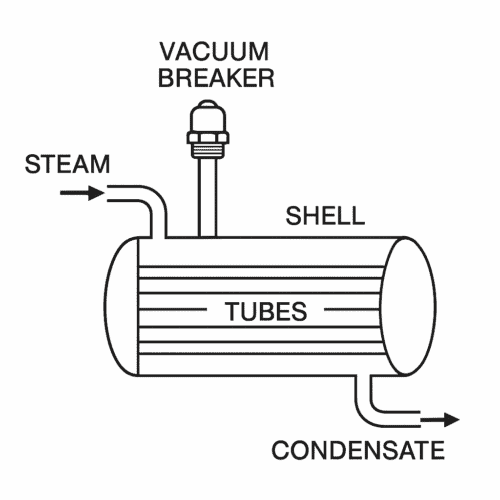
A vacuum breaker is a simple, spring-loaded valve that allows air into a closed system when internal pressure drops below atmospheric pressure. In steam systems, this prevents a vacuum from forming as steam condenses—avoiding damage and performance issues.
Why Heat Exchangers Warrant Vacuum Breakers
In a shell-and-tube heat exchanger, steam condenses inside the shell to transfer heat to the fluid in the tubes. As it condenses, it can create a vacuum, which introduces two types of problems:
Mechanical Risk: If the shell isn’t strong enough to handle the pressure differential, it can collapse—think of crushing an empty soda can. A vacuum breaker prevents this. Vacuum conditions can also cause water hammer when steam rushes back in, leading to loud noises and potential damage.
Performance Impact: Even if the exchanger is mechanically rated for vacuum, some processes aren’t designed to operate under vacuum pressure. It can alter the thermal or mechanical properties of fluids, hinder condensate drainage, and cause the system to operate inefficiently.
Installing a vacuum breaker allows air to enter the shell, equalizing pressure and preventing these issues.
Installing a Vacuum Breaker: Best Practices
Proper installation is key to ensuring your vacuum breaker functions correctly:
Location: Install the vacuum breaker at the top of the heat exchanger shell or on the steam supply line near the exchanger. This placement allows air to enter where the vacuum forms.
Orientation: Mount the vacuum breaker vertically with the cap facing upward to ensure proper operation.
Isolation Valve: Include an isolation valve below the vacuum breaker to facilitate maintenance without shutting down the entire system.
Maintenance: Periodically inspect the vacuum breaker for debris or wear. While many models are not repairable, regular checks can prevent unexpected failures.
Vacuum Breakers on Enerquip Shell & Tube Heat Exchangers
So, where does Enerquip fit into this?
Our standard heat exchangers—also known as tabulated or stock designs—are engineered to withstand vacuum conditions. That means they’re strong enough to avoid collapse without needing a vacuum breaker for mechanical reasons.
However, larger or custom units may not be rated for vacuum by default. That’s because vacuum-rated designs often require thicker materials, which can significantly increase cost. In these cases, we calculate for vacuum only if requested.
From a performance standpoint, though, even a structurally robust system may require a vacuum breaker or pressure relief device installed on the exchanger or in the process piping to ensure the system operates as expected. That’s why nearly every Enerquip exchanger includes a small vent connection on the shell—giving you (or your installer) the flexibility to add a vacuum breaker when needed.
Bottom Line
Incorporating a vacuum breaker into your heat exchanger system is a small investment that can prevent damage and downtime. By allowing air into the system when needed, it maintains pressure balance and ensures efficient operation. Regular maintenance and proper installation are key to maximizing its benefits.
Comments Off on Glycol Dehydration: Removing Water for Safer Natural Gas Transport
Natural gas is a key energy source, but before it reaches consumers, it must go through several refining steps to ensure safety and efficiency. One of the most important processes in gas treatment is glycol dehydration, which removes water vapor from natural gas. Without it, pipelines and equipment could suffer from corrosion and dangerous blockages.
How Glycol Dehydration Works
Glycol dehydration is a liquid desiccant process that absorbs water from natural gas. Here’s a breakdown of how it works:
1. Wet Gas Enters the System
Natural gas containing water vapor flows into a contactor tower, where it meets the dehydration agent—typically triethylene glycol (TEG).
2. Glycol Absorbs Water
As the gas rises through the tower, the glycol moves downward, absorbing the water from the gas stream. This leaves the gas dry and ready for transport.
3. Dry Gas Exits
The dehydrated gas exits the top of the tower and continues its journey through pipelines or further processing.
4. Glycol Regeneration
The water-laden glycol (called rich glycol) is sent to a reboiler, where heat separates the water from the glycol. This allows the glycol (now lean glycol) to be reused in the system.
5. Water Disposal
The extracted water is vented or properly disposed of, ensuring a continuous and efficient dehydration process.
Why Glycol Dehydration Matters
Removing water from natural gas isn’t just about meeting industry standards—it’s about safety, efficiency, and reliability. Here’s why this process is essential:
Prevents Hydrate Formation – At high pressures and low temperatures, water and gas can form hydrates—ice-like solids that clog pipelines and equipment. Glycol dehydration eliminates this risk.
Reduces Corrosion – Water mixed with natural gas can lead to pipeline corrosion, causing costly damage and potential leaks.
Ensures Gas Quality – Natural gas must meet pipeline moisture specifications before transportation. Proper dehydration ensures compliance and prevents costly processing delays.
A Critical Step in Gas Processing
From natural gas processing plants to offshore platforms, glycol dehydration plays a vital role in keeping gas flowing safely and efficiently. Without it, the industry would face severe operational and safety challenges.
Understanding processes like glycol dehydration highlights the complexity behind energy production and the measures taken to deliver clean, reliable fuel. If you work in natural gas processing, ensuring an efficient dehydration system is crucial for long-term success.
Comments Off on Offshore Heat Exchangers & Thermal Fluid Heaters: Key Design Considerations for Harsh Marine Environments
Imagine you’re miles offshore, surrounded by nothing but the open ocean and the hum of operating equipment. Out here, your process systems must battle saltwater corrosion, extreme weather, and tight space constraints—all while keeping operations running safely and efficiently. Offshore heat exchangers and industrial heating systems must withstand constant exposure to corrosive elements, intense conditions, and demanding operational challenges. With the right engineering approach, offshore heating solutions can deliver reliable performance while mitigating safety risks.
Today, we’re diving into key offshore design considerations and how Enerquip’s expertise helps navigate the process with tailored solutions for offshore operations.
Designing for Reliable Performance in Marine Environments
Offshore installations face ongoing exposure to corrosion from the surrounding saltwater and humid air. Selecting the right materials is a critical step in designing a system that can withstand these conditions long-term. Materials like 316L stainless steel, duplex stainless steel, and titanium are top contenders due to their resilience in harsh, corrosive environments. Titanium, in particular, stands out for its exceptional corrosion resistance after prolonged exposure to seawater.
Offshore heat exchanger and industrial heater designs must be robust enough to withstand high winds, heavy rainfall, and extreme temperatures. Protective measures, such as NEMA 4X-rated control panels for industrial heating systems, are important to ensure reliable outdoor use. Further, designing with temperature fluctuations in mind and incorporating splash protection helps extend equipment longevity.
Efficiency and Heat Loss Mitigation
Smaller, more efficient designs are often necessary to accommodate space and weight constraints. Helical coil thermal fluid heaters are a prime example of compact, efficient equipment designs that can meet the unique design requirements of offshore applications. These conserve space and reduce the structural load on platforms, effectively addressing size and weight concerns.
Insulation is another important design factor to consider. Offshore conditions like high winds and cold temperatures can sap heat, hindering the system’s efficiency. High-performance insulation can help protect equipment from these conditions, improving overall thermal efficiency by capturing and reusing waste heat.
Power Supply and Safety Considerations
Offshore platforms often operate with limited power generation capabilities. Incorporating backup power supplies and fail-safe mechanisms is crucial for maintaining operations during outages. Additionally, emergency shutdown features prevent accidents and system damage.
Implementing these in heater designs keeps operations running smoothly in offshore environments and strengthens overall system reliability.
Explosion Protection
The presence of flammable gases near oil and gas rigs calls for stringent explosion protection measures. Equipment must meet standards such as:
NEC Class I, Division 1/2 (USA) – Defines hazardous locations
Using explosion-proof components with heavy-duty insulation materials is important to maintain a safe operating environment. You’ll also want to make sure that all electrical systems are appropriately rated for use in hazardous areas.
Maintenance and Accessibility
Regular maintenance in offshore environments can be challenging. Designing equipment with easy-access features like removable panels and quick-connect systems makes maintenance work easier to complete. Additionally, incorporating remote monitoring capabilities allows for early detection of issues, which minimizes downtime and maintenance expenses.
Environmental Compliance
Strict environmental regulations govern offshore installations, especially concerning emissions and discharges. Ensuring equipment meets these standards is vital to both legal compliance and marine ecosystem protection.
Key strategies for environmental compliance:
Design systems to minimize emissions
Implement leak-prevention technology
Use efficient fuel sources to lower environmental impact
Enerquip’s Expertise in Offshore Thermal Solutions
Navigating the complexities of offshore heating solutions requires a partner with specialized knowledge and experience. Enerquip stands out in this arena, offering tailored solutions that address the unique challenges of offshore environments. From corrosion-resistant materials to compact designs and energy-efficient systems, Enerquip’s offshore heat exchangers and industrial heaters are designed to meet the rigorous demands of offshore applications.
If you’re looking to optimize your offshore heating systems or need guidance on selecting the right equipment, Enerquip’s team is ready to help. Contact us for more information or request a quote to get started.
Comments Off on Enerquip Supports Local STEM Education with Donation to Medford Science Olympiad
Enerquip is proud to support local STEM education with a $500 donation to the Medford Area Senior High (MASH) Science Olympiad program. This contribution will help fund the team’s participation in competitions and provide valuable resources for student learning and development.
Science Olympiad is a nationally recognized program that challenges students through team-based competitions across a wide range of STEM subjects, including Life Science, Earth Science, Chemistry & Physics, Technology, and Scientific Inquiry. The program emphasizes collaboration, critical thinking, and hands-on problem-solving, giving students real-world experience in science and engineering.
“The MASH Science Olympiad team includes students with diverse interests and academic strengths,” says Mr. Bradley Paff, MASH Science Teacher and Science Olympiad Mentor. “These dedicated students spend countless hours preparing for events, developing leadership, teamwork, and analytical skills that serve them well beyond the classroom.”
The donation was made possible through Enerquip’s Employee Match Program. Administrative Specialist Shelly Matthias selected the MASH Science Olympiad team as the recipient of her matched contribution, combining her personal support with the company’s to make a greater impact.
“Programs like Science Olympiad help equip the next generation with the skills and confidence to pursue careers in STEM fields — and we’re honored to play a small part in that journey,” said Shanna Scheithauer, Director of Accounting & HR at Enerquip. “At Enerquip, we’re proud to stand behind our employees and the causes they care about.”
Enerquip’s Employee Match Program reflects this commitment by matching employee donations and volunteer hours 100%, up to $500 per employee each calendar year.
For more information about Enerquip’s community giving initiatives, click here.
Comments Off on Enerquip’s Employee Match Supports First Baptist Church
Enerquip recently donated $1,000 to First Baptist Church (FBC) of Medford through its Employee Match Program. The funds will support a variety of church initiatives, including outreach ministries that serve individuals and families of all ages.
“We’re grateful for local businesses like Enerquip who come alongside us in our mission,” said George Myers, Associate Pastor at First Baptist Church. “This donation helps us extend our outreach and strengthen our ministries—and it’s a great example of how faith communities and local businesses can work together for the greater good.”
FBC is a Christ-centered community dedicated to “Treasuring God, Loving People.” Since its founding in 1944, the church has grown into a vibrant congregation of hundreds offering Sunday worship, Bible studies, youth programs like Awana, and outreach efforts such as its long-standing food pantry. Rooted in the authority of Scripture, FBC emphasizes living out the Gospel through both word and deed—welcoming all who seek faith, fellowship, and community.
Enerquip’s Employee Match Program reflects the company’s commitment to giving back. The program matches employee donations—financial or volunteer-based—dollar-for-dollar, up to $500 per team member annually.
This donation was made possible through the contributions of Jeannie Deml, Enerquip President & CEO, and Lindsey Mayer, Marketing & Communications Manager. Both Deml and Mayer actively volunteer at First Baptist, serving on multiple committees and supporting its mission through personal time and resources.
Enerquip Thermal Solutions uses cookies to give you a more personalized experience on our website. If you continue to use our services, we assume that you accept such use. Learn more about cookies and how you can refuse them on our Privacy Policy page.


 When it comes to keeping your